


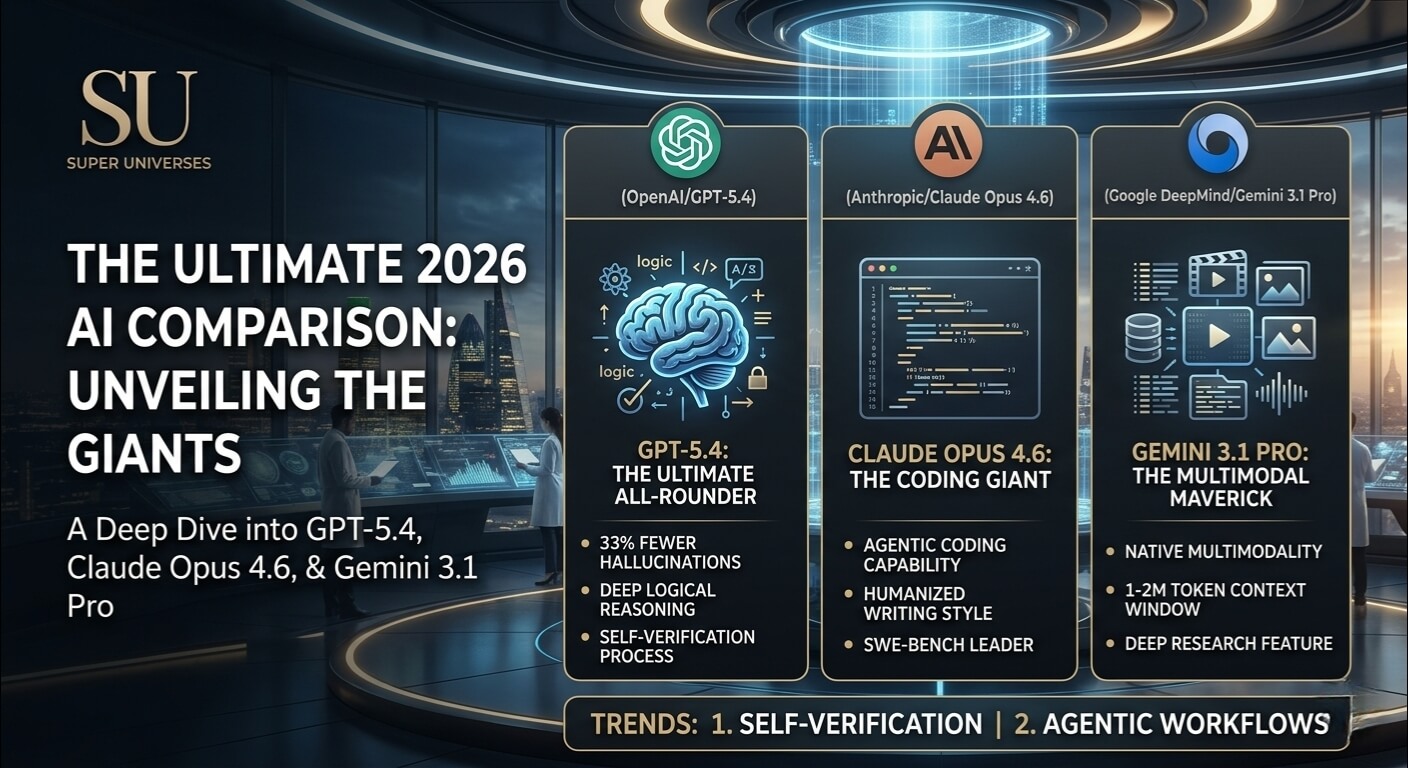

From Information to Deep Thinking: The Ultimate Breakdown of 2026’s Top 3 AI Models
In 2026, artificial intelligence has been taken to a whole new boundary. In the history of AI’s evolution, the year 2026 is being considered a milestone. The main reason for this is that AI no longer just gathers information from somewhere else, but rather performs deep thinking and self-verification like a human to give answers.
In terms of global ranking and effectiveness, the top 3 AI models currently are GPT-5.4 (OpenAI), Claude Opus 4.6 (Anthropic), and Gemini 3.1 Pro (Google DeepMind).
You have certainly read articles about these. But in my article today, I will do a completely deep discussion about them. As a result, I hope you will get to know many new things.
1. The Ultimate All-Rounder GPT-5.4
OpenAI released their latest and flagship model GPT-5.4 in March 2026. It is basically a unified system that can understand the complexity of a prompt and intelligently route data.
Technical Features and Architecture
The GPT-5.4 model gives about 33% less hallucination or wrong information than its previous versions. Because its biggest strength is its “Thinking” or “Reasoning” version. I have noticed that when I give any mathematical problem or logical code to this model, it does not give the answer directly, but rather thinks step-by-step in the backend like a human, and corrects its own mistakes which is called self-verification. Its context window currently supports up to 1 million tokens.
Main Strength of GPT
-
Logical Reasoning: In various complex business decisions, data analysis, and strategic planning, no one is even close to it yet. In BenchLM.ai‘s overall benchmark, it is at the very top with a score of 92.
-
Task Routing: When you ask it a small or simple question, it gives an instant answer at a lower cost, but in the case of complex questions, it goes into deep thinking mode on its own.
Fields of Use
-
If you give it proper commands, it can write a deep research-based article of over 1500 words or document legal papers flawlessly.
-
It is highly effective in creating complex predictive modeling for banking systems and market verification.
2. The Coding Giant Claude Opus 4.6
Anthropic brought their most powerful version Claude Opus 4.6 to the market in February 2026. From professional writers to coders and researchers, it is the most popular and trusted AI of the current time.
Technical Features and Architecture
Claude Opus 4.6 has been designed as a “hybrid reasoning model”. It is ahead of any AI in the world in creating human writing styles. Its biggest technical breakthrough has come for its agentic coding capability. You will not believe that it can work Autonomously for hours after hours. Another interesting thing is that Anthropic has added a special ‘Agent SDK’ for it.
Main Strength
-
Professional Coding and Debugging: In SWE-bench, which measures AI’s software engineering skills, Claude Opus 4.6 and its sister models are the industry leaders on verified benchmarks. It is the key or driving force behind popular AI-native coding environments like Cursor, Windsurf, and Claude Code.
-
Humanized Writing: Its content generation style is so natural that common AI detectors like Originality.ai or GPTZero cannot catch Claude Opus’s writing. It presents information very smoothly without any mechanical words.
Fields of Use
-
The software development of Claude Opus has been made for complete legacy codebase refactoring or designing the backend or frontend of any new web app.
-
It writes Google AdSense and SEO friendly high-value blogging and content which feels exactly like human writing.
3. The Multimodal AI Gemini 3.1 Pro
Google DeepMind launched their Gemini 3.1 Pro version at the beginning of 2026. Actually, Google created this AI based on native multimodality without any external modules.
Technical Features and Architecture
Gemini 3.1 Pro is built on the Sparse Mixture-of-Experts (Sparse MoE) architecture. Its main specialty is that it can process text, audio, images, and high-quality video at the same time. In April 2026, it set a world record by scoring 94.3% in scientific and research benchmarks like GPQA Diamond and 77.1% in ARC-AGI-2.
Main Strength
-
Huge Context Window and Deep Research: Due to having a 1 to 2 million token context window, it can take in long-length videos of hours after hours or thousands of pages of research papers all at once. Because of Google’s Deep Research feature, it scrapes hundreds of sources from the internet in real time and gives accurate reports.
-
Cost Effectiveness: Google gave this generational upgrade to their users without any extra cost, making it highly cost-effective at the enterprise level.
Fields of Use
-
For multimedia analysis, uploading any video file and analyzing its script, finding specific events inside the video, or extracting data from audio tracks is very easy for Gemini.
-
Deep analysis of complex scientific data sets, medical imaging, and legal case studies is absolutely the best thing to me and to the users.
Comparison Table of These 3 AI Models
For your convenience of understanding, a table is given below to easily understand the capability of these top 3 models:
| Feature / Benchmark | OpenAI GPT-5.4 | Claude Opus 4.6 | Gemini 3.1 Pro |
| Primary Focus | All-round Reasoning & Logic | Coding & Natural Writing | Native Multimodality & Research |
| Context Window | 1 Million Tokens | 1 Million Tokens (Up to 128K Output) | 1 to 2 Million Tokens |
| Coding Efficiency (SWE-bench) | High (65% – 70%) | Top Tier (70.6%+) | High (53.6%+) |
| Scientific Reasoning (GPQA) | ~89.4% | ~85.0% | Top Tier (94.3%) |
| Writing & Prose Quality | Excellent but somewhat formal | Outstanding (Human-like Nuance) | Informative and structured |
| Real-time Web Browsing | Excellent (Bing Integrated) | Great (Web Search Enabled) | Best-in-class (Google Search Infrastructure) |
Which Way Are We Going with the AI Trend at Present?
If we deeply analyze these 3 AI models, two main trends clearly surface:
-
A. Self-Verification: AI of previous models used to claim a wrong answer was correct even if it was wrong, which made users confused. But now, they cross-check their own logic in the backend before giving the answer. Because of this, the accuracy of information has increased a lot.
-
B. Agentic Workflow: AI is no longer just a “copilot” or simple assistant. If you give a big goal to Claude Opus 4.6 or GPT-5.4 (such as: “Do an SEO audit for my site and fix the sitemap dealing”), they can open browser tabs one after another, write code, and call APIs to finish the job without human help.
My Opinion as a User
Standing at the present time, we cannot call any single model the best, this is almost impossible. Because everyone is giving their best from their side. No one is behind anyone.
- If you want solutions to complex logical problems or need business strategies or long documentation, then GPT-5.4 will be your first choice. I get various business strategies or long writings made from ChatGPT for my page Super Universe.
- If you are a developer or need content that will not be caught in any AI detector and will look exactly like a human while reading, then Claude Opus 4.6 is absolutely perfect for you. I have seen many of my known friends get long content written with this, and my younger brother takes its help for coding.
- If your work is with video, audio, images, or deep research with huge datasets, then there is no alternative to Google’s Gemini. Because I get all the AI edits or pictures made for my page from Gemini.