


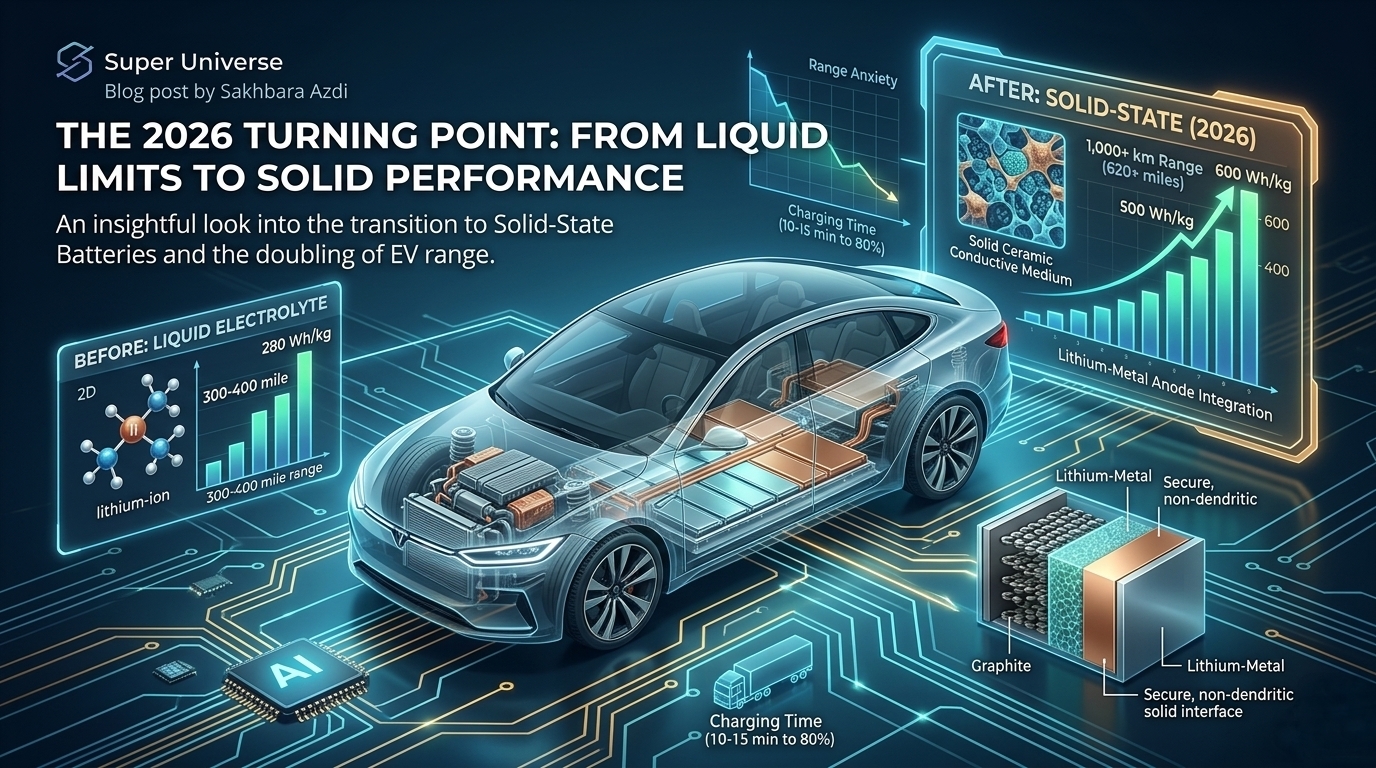

The 2026 Turning Point: From Liquid Limits to Solid Performance
For the past decade, the electric vehicle (EV) revolution has been tethered to the limitations of liquid electrolytes. While lithium-ion batteries transformed the automotive landscape, they hit a “density ceiling” that made 400 miles of range a luxury and 600 miles a near-impossible engineering feat without massive, heavy battery packs. In 2026, the industry is undergoing its most significant chemical pivot: the transition to Solid-State Batteries (SSBs).
By replacing the flammable liquid electrolyte with a solid conductive medium—typically ceramic, sulfide, or polymer—manufacturers are finally decoupling energy capacity from weight. This shift is not just an incremental improvement; it is a total reimagining of the battery’s “failure physics” and energy potential. As of April 2026, we are seeing the first production-ready cells capable of doubling the range of standard EVs, effectively ending the era of “range anxiety” for the mass market.
The Energy Density Leap: Targeting 500 Wh/kg
The primary advantage of solid-state chemistry is its incredible energy density. Standard lithium-ion cells in 2024–2025 typically capped out at roughly 260–300 Wh/kg. In 2026, all-solid-state prototypes from leaders like Toyota, Samsung, and CATL are hitting 400–500 Wh/kg, with laboratory proof-of-concepts from firms like Chery already demonstrating a staggering 600 Wh/kg.
This doubling of density allows for two radical design paths:
-
Extreme Range: Fitting a 150 kWh solid-state pack into a standard sedan footprint, enabling a range of 1,000+ kilometers (620+ miles) on a single charge.
-
Ultra-Light Efficiency: Using a much smaller, lighter battery pack to achieve a 300-mile range, significantly reducing the vehicle’s weight and improving handling, braking, and tire wear.
Lithium-Metal Anodes: The 10x Capacity Game-Changer
The “secret sauce” of the 2026 breakthrough is the integration of lithium-metal anodes. In traditional batteries, anodes are made of graphite, which acts as a “scaffolding” to hold lithium ions. While stable, graphite takes up significant space and weight. Because solid electrolytes are physically robust and can prevent the growth of “dendrites” (microscopic spikes that cause shorts), they allow for the use of pure lithium metal as the anode.
Lithium metal has a theoretical capacity of 3,860 mAh/g, which is roughly ten times the lithium content of graphite. In 2026, this “stepwise climb” from graphite to high-silicon composites and finally to lithium metal is what is physically enabling the doubling of range. We are effectively packing more “fuel” into the same volume without the risk of the battery catching fire.
Thermal Resilience and the 10-Minute Charge
Beyond range, solid-state chemistry has solved the “Thermal Runaway” problem. Traditional batteries can ignite if punctured or overstressed because their liquid electrolytes are highly flammable. Solid electrolytes are inherently non-flammable and can tolerate much higher temperatures (up to 247°C compared to just 90°C for liquid systems).
This thermal stability directly translates to ultra-fast charging. Because the cells can handle higher current densities without overheating, 2026’s solid-state EVs can charge from 10% to 80% in under 15 minutes. Some specialized aviation-grade cells, like Sunwoda’s “Aviation Battery 2.0,” are even pushing the boundaries for eVTOL aircraft, proving that the tech is robust enough for flight.
The Commercial Roadmap: Semi-Solid Now, All-Solid Soon
While “All-Solid” batteries are the ultimate goal, 2026 is the year of the Semi-Solid Battery. Chinese manufacturers like NIO and Gotion Hi-Tech have already moved into volume production with semi-solid cells (300–350 Wh/kg), providing a “bridge” technology that offers 577 miles of range in current production models.
-
2024–2026: Rollout of semi-solid packs in high-end EVs (NIO, Dongfeng).
-
2027: Small-series production of All-Solid-State EVs (Toyota prototypes, CATL).
-
2028–2030: Full-scale mass adoption as manufacturing costs drop and “interface resistance” issues are solved at scale.
The Economic Impact of the Range Double
The doubling of range is triggering a “Circularity Shift” in the automotive market. As EVs become capable of 1,000 km ranges, the secondary market for used EVs is stabilizing, as “battery health” concerns diminish with the increased cycle life of solid-state cells (targeted at 2,000+ cycles).
Furthermore, the “Hydrogen Horizon” for heavy trucking is being challenged by these batteries. Long-haul commercial trucks, which previously required hydrogen to achieve meaningful range, are now looking toward 500 Wh/kg solid-state packs as a more efficient and infrastructure-ready alternative.
A New Era of Mobility
The solid-state breakthrough of 2026 represents more than just a better battery; it is the final nail in the coffin for the internal combustion engine. By doubling the range, slashing charge times, and eliminating fire risks, solid-state chemistry has transformed the EV from a “compromised” alternative into the undisputed superior technology.
We are entering a world where “refueling” an EV takes the same time as a coffee break, and a single charge can carry a family across an entire country. The “Battery Breakthrough” is the silent engine of 2026, powering a cleaner, faster, and more resilient future for global transportation.
As you look at your own “freelance” or “work-from-home” setup, does the prospect of a 600-mile EV change how you think about “remote work” and the ability to travel while maintaining your productivity?