


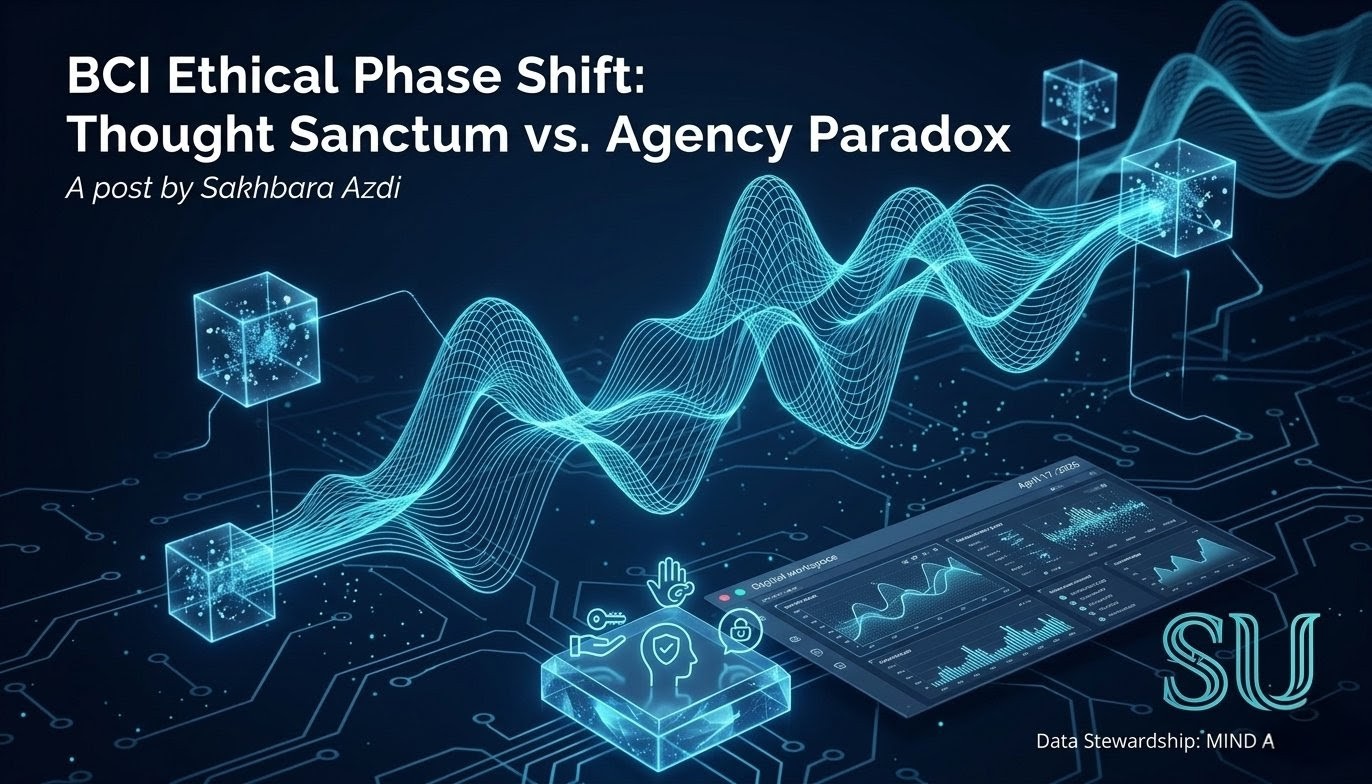

The date is April 17, 2026, and we are standing at the threshold of a biological and digital synthesis that was, until very recently, the exclusive domain of science fiction. In the last twenty-four months, Brain-Computer Interface (BCI) technology has undergone a phase shift. We have moved past the initial “proof of concept” phase—where paralyzed patients used their thoughts to move a cursor or play a game of chess—into a more complex and ethically fraught era of high-bandwidth, bidirectional communication.
With the recent launch of Paradromics’ Connect-One clinical trials and the expansion of Neuralink’s human study cohorts, the “digital bridge” between the human mind and external machines is becoming more robust. However, as the latency between thought and action disappears, we are discovering that the most significant challenges are not engineering hurdles, but ethical ones. Direct brain-to-computer communication forces us to confront fundamental questions about the nature of the self, the sanctity of our internal thoughts, and the very definition of human rights in an augmented age.
The Erosion of Cognitive Liberty and Mental Integrity
The most profound ethical implication of BCI technology in 2026 is the potential erosion of Cognitive Liberty. Historically, the human mind has been the ultimate “black box”—the only place where an individual could possess absolute privacy and autonomy. We have always had the right to think whatever we want, even if those thoughts are never voiced. Neural interfaces threaten to dismantle this final sanctuary.
When we create a high-speed data link to the brain, we are essentially creating a backdoor to the consciousness. In early 2026, bioethicists have begun to sound the alarm over “Neuro-Coercion.” If an employer, a government, or even a commercial entity can monitor neural activity, can we truly say we have free will? For example, if a company utilizes non-invasive BCI headsets to monitor “employee engagement” or “fatigue levels” in real-time, it creates a subtle but powerful pressure on the employee to self-censor their own mental states. This is a violation of Mental Integrity—the right to be free from uninvited changes to, or monitoring of, one’s mental life. As we move further into 2026, the legal framework of Habeas Corpus (the right to the body) is being expanded by advocates into Habeas Cogitationem—the right to the thought.
The Neuroprivacy Paradox: Data Ownership in the Age of “Telepathy”
In the digital world of 2026, data is the most valuable commodity. But neural data—the raw, high-frequency electrical signals of your neurons—is different from your browsing history or your GPS coordinates. Neural data is the “source code” of your identity.
The Paradromics system, for instance, uses over 400 micro-needle electrodes to record from individual neurons at rates exceeding 200 bits per second. This level of resolution doesn’t just capture the command to “move my hand”; it captures the emotional “flavor” surrounding that command. It captures biases, subconscious reactions, and even fragmented memories that the user may not be intentionally sharing.
The ethical dilemma here is twofold:
-
Decoding Intent vs. Subconscious Activity: How do we ensure that a BCI only “reads” what the user intends to communicate, rather than everything that is happening in the brain?
-
The “Harvest Now, Decrypt Later” Threat: Much like the quantum threat we discussed regarding traditional encryption, neural data harvested today could be decoded with much greater precision by the AI models of 2030. This makes “Neural Privacy” a long-term security risk that requires immediate, stringent regulation.
In response, the U.S. Congress introduced the 2025 MIND Act, which began taking full effect in early 2026. This landmark legislation classifies neural data as “Highly Sensitive Biometric Information,” prohibiting its sale and requiring explicit, revocable consent for its collection. However, as BCI companies move toward a “patient-owned” data model, the burden of protecting this data increasingly falls on the individual, who may not fully grasp the long-term implications of their “digital twin” being stored in the cloud.
The Problem of Agency and the “Black Box” of AI
One of the most unsettling ethical questions in the 2026 BCI landscape is the Agency Problem. Most modern neural interfaces do not simply “pass through” a signal; they use sophisticated AI to “decode” and “interpret” what the user is trying to do. Because the AI is acting as an intermediary, it creates a “Black Box” between the user’s intent and the resulting action.
If a paralyzed patient uses a robotic arm to pick up a cup, and the arm accidentally knocks the cup over, who is responsible?
-
Was it a “mis-thought” by the patient?
-
Was it a “mis-interpretation” by the AI?
-
Was it a mechanical failure of the hardware?
This ambiguity of agency is not just a legal headache; it is a psychological one. Some early BCI participants have reported a sense of “diminished self,” where they feel as though the machine is “guessing” their desires rather than truly obeying them. In 2026, we are forced to define where the “Human” ends and the “Algorithm” begins. As we integrate these tools into the Augmented Reality Office and our daily workflows, maintaining a clear sense of personal agency will be critical to our mental health and our legal accountability.
The “Neuro-Divide”: Equality and the Augmented Elite
As BCIs move from medical necessity to elective enhancement, we face the risk of a permanent Neuro-Divide. Elon Musk has frequently cited the need for a “high-bandwidth interface” to keep humans competitive in an era of Super-Intelligent AI. While this sounds like a noble goal, it carries a dark subtext of inequality.
If a neural interface can double your learning speed, give you 20/10 vision through a “Blindsight” implant, or allow you to communicate via “synthetic telepathy,” it becomes an ultimate tool for social and economic advancement. If this technology is only available to the wealthy or those in specific geographic regions, we risk creating a biological caste system. In 2026, the global conversation has shifted toward whether “Cognitive Enhancement” should be a fundamental human right or a regulated medical procedure. The UNESCO Recommendation on the Ethics of Neurotechnology, adopted in late 2025 and currently being implemented globally in 2026, explicitly warns against the “commodification of cognition” and calls for equitable access to neuro-technological advancements.
Informed Consent and Vulnerable Populations
The ethics of informed consent are particularly complex when dealing with the brain. Many of the early adopters of BCI technology are patients with severe disabilities, such as ALS or “locked-in” syndrome. These individuals are often in a state of high vulnerability, and their desire for restored function may lead them to accept risks they do not fully understand.
In 2026, the medical community is grappling with the “Permanence” of these devices. Unlike a wearable headset, an invasive BCI (like those from Neuralink or Paradromics) requires neurosurgery. If the company providing the service goes bankrupt or the technology becomes obsolete, the user is left with a piece of “dead” hardware in their brain. The ethical mandate for 2026 is “Long-Term Stewardship”—ensuring that patients have a clear “off-ramp” and that the companies responsible for these devices have the financial and legal obligation to support them for the lifetime of the user.
Toward a “Neuro-Constitutional” Future
As we navigate the complexities of April 2026, it is clear that we are at a crossroads. Neural interfaces offer a degree of liberation and healing that was previously unimaginable. They can restore sight to the blind, a voice to the silent, and mobility to the paralyzed. But this power comes with a price: the potential loss of our most fundamental privacy.
To ensure that the “Microbiome Connection” and the “Battery Breakthrough” of our era are matched by ethical progress, we must codify Neuro-Rights at the highest levels of governance. We need:
-
Mental Privacy: The right to keep our neural signals away from the marketplace.
-
Psychological Continuity: The right to remain “ourselves” despite our augmentations.
-
Decisional Sovereignty: The right to ensure that our thoughts are our own, free from “algorithmic nudging.”
The future of the human-machine interface is not just a technological challenge; it is a battle for the soul of what it means to be human. As we bridge the gap between neurons and silicon, we must ensure that the bridge remains a tool of empowerment, not a tether of control. The “Hydrogen Horizon” of our consciousness is here—it is up to us to ensure that it remains bright, private, and truly our own.
As you look at the 3D visualization of your own home office, or consider your next project on Fiverr, ask yourself: would you be willing to give up the privacy of your “Inner Sanctum” for a 10x boost in productivity? In 2026, that is no longer a hypothetical question.