


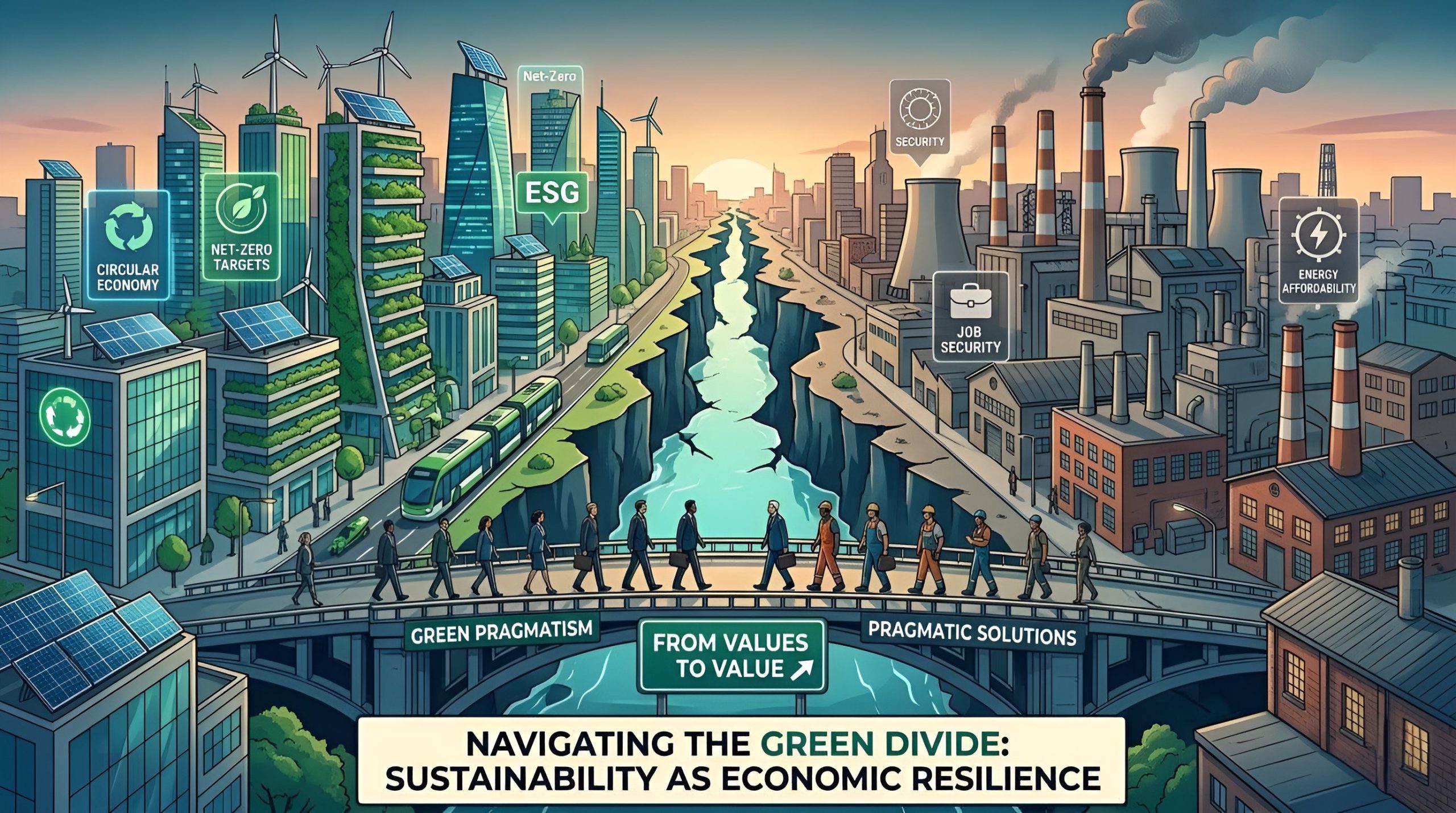

The conversation surrounding environmental sustainability has shifted from a scientific consensus into one of the most significant fault lines in the modern global economy. As we navigate the complexities of 2026, corporate leaders find themselves at a difficult crossroads, managing what is now known as the “Green Divide.” On one side of this divide is an aggressive push for Net-Zero targets, circular economies, and stringent ESG (Environmental, Social, and Governance) compliance. On the other side is a growing wave of “green skepticism,” driven by economic anxiety, political polarization, and a rejection of what some perceive as “sustainability overreach.” Navigating this polarized landscape requires a new strategy—one that moves beyond virtue signaling and anchors sustainability in pragmatic, economic resilience.
The Anatomy of the Green Divide
The Green Divide is not merely a disagreement over climate change; it is a conflict over the speed, cost, and equity of the transition to a low-carbon economy. In many developed urban centers, sustainability is viewed as a moral imperative and a massive market opportunity. However, in industrial heartlands and developing regions, the same green policies are often viewed as threats to job security, energy affordability, and national sovereignty.
This polarization has created a “split-screen” reality for multinational corporations. A company may face intense pressure from institutional investors in Europe to decarbonize its entire supply chain, while simultaneously facing legal challenges or consumer boycotts in other regions for prioritizing “woke” environmental agendas over shareholder returns. Managing this divide is no longer just an environmental task; it is a masterclass in stakeholder diplomacy and strategic positioning.
Moving from “Values” to “Value”
To bridge this divide, the most successful organizations are reframing sustainability. They are moving away from the language of “corporate social responsibility,” which can feel abstract or politically charged, and moving toward the language of “operational efficiency” and “risk mitigation.”
When sustainability is presented as a way to reduce waste, lower energy costs, and secure supply chains against climate-related disruptions, it becomes a non-partisan business objective. For example, transitioning to a circular manufacturing process isn’t just about “saving the planet”—it’s about reducing the volatility of raw material prices. Investing in renewable energy isn’t just a “green” move—it’s a way to lock in long-term energy price stability in an era of geopolitical instability. By anchoring green initiatives in tangible “value” rather than debated “values,” companies can build broader coalitions of support.
The Rise of Green Pragmatism
We are seeing the emergence of “Green Pragmatism,” a middle-ground approach that acknowledges the reality of the climate crisis while respecting the economic constraints of the present. This approach prioritizes “transitional” technologies and incremental improvements over “all-or-nothing” radical shifts that risk alienating large segments of the economy.
Green pragmatism involves:
-
Decarbonization without Deindustrialization: Finding ways to lower the carbon footprint of essential industries—like steel, cement, and shipping—without making them economically unviable.
-
Energy Pluralism: Supporting a diverse energy mix that includes renewables alongside bridge fuels and advanced nuclear power to ensure grid reliability and affordability.
-
Inclusive Transitioning: Ensuring that the “green” workforce includes pathways for those currently employed in traditional energy sectors, preventing the social friction that fuels political polarization.
The Data Transparency Mandate
In a polarized economy, trust is the scarcest resource. The Green Divide is often exacerbated by “greenwashing”—the practice of making misleading environmental claims. To combat skepticism, organizations must embrace radical data transparency.
This means moving beyond glossy sustainability reports and toward real-time, audited environmental data. With the rise of blockchain-enabled supply chain tracking and satellite-based emissions monitoring, companies can now provide verifiable proof of their environmental impact. Transparency acts as a bridge; it satisfies the demands of climate advocates for accountability while providing critics with the hard evidence needed to justify green investments as sound business decisions.
Navigating the Regulatory Patchwork
The polarization of the economy has led to a fragmented regulatory landscape. Some jurisdictions are doubling down on carbon taxes and mandatory disclosures, while others are passing “anti-ESG” legislation. This creates a “compliance minefield” for global businesses.
Strategic localization, as discussed in other contexts, becomes vital here. Companies must develop the agility to comply with high-standard environmental regulations in one region without inadvertently violating “neutrality” laws in another. This often involves creating “modular” sustainability programs—core environmental goals that are implemented through region-specific tactics that respect local political and economic realities.

Sustainability as Innovation, Not Just Compliance
One of the most effective ways to bypass the polarization of the Green Divide is to treat sustainability as a driver of innovation. When a company develops a new material that is both cheaper and more sustainable than the plastic it replaces, the debate over “green” becomes irrelevant. The market adopts the innovation because it is simply a better product.
By shifting the focus from “complying with rules” to “solving problems,” companies can move the conversation into the realm of human ingenuity. Innovation is a universal language that appeals to both the environmental activist and the venture capitalist. It turns the green transition from a series of “don’ts” (don’t pollute, don’t use carbon) into a series of “dos” (do invent, do optimize, do lead).
The Role of the Consumer in a Polarized Market
Consumer behavior is also reflecting the Green Divide. While there is a growing segment of “conscious consumers” willing to pay a premium for sustainable goods, there is an equally large segment that is “green-fatigued.” This latter group is primarily focused on price, quality, and reliability.
The challenge for brands is to achieve “Green Parity”—creating sustainable products that do not require the consumer to compromise on performance or price. When sustainability becomes “invisible” because it is seamlessly integrated into a superior product experience, the polarization of the consumer market begins to dissolve. The goal is to make the “green” choice the “obvious” choice for everyone, regardless of their political leanings.
The “S” in ESG: The Human Element of the Transition
Managing the Green Divide requires a renewed focus on the “Social” aspect of sustainability. A green transition that leaves communities behind will always face political resistance. This is where “Just Transition” strategies come into play.
Companies that are closing old facilities or moving away from carbon-intensive processes must invest in the reskilling of their local workforces. By providing a clear bridge to the new economy, businesses can turn potential critics into stakeholders. When a community sees a new “green” factory not as a symbol of outside ideology, but as a source of local pride and high-quality jobs, the Green Divide begins to narrow.
Resilience in a Volatile Climate
Ultimately, the most compelling argument for sustainability in a polarized economy is resilience. We are entering an era of increased climate volatility—more frequent extreme weather events, shifting agricultural zones, and water scarcity.
A company that ignores these realities in the name of avoiding “green politics” is simply failing at risk management. Building resilience—through water-efficient cooling systems, climate-hardy supply chains, and decentralized energy—is a matter of survival. Even the most ardent skeptics can agree on the importance of “hardening” a business against physical disruption. By framing sustainability as “Climate Resilience,” leaders can bypass ideological traps and focus on the fundamental task of protecting the organization’s future.
Conclusion: Leading Through the Divide
The Green Divide is a permanent feature of the 2026 landscape, but it does not have to be a barrier to progress. Leading through this divide requires a blend of empathy, pragmatism, and unflinching data. It requires the ability to speak multiple “languages”—the language of the investor, the activist, the regulator, and the skeptical employee.
By moving beyond the hype and anchoring environmental goals in the bedrock of economic value, innovation, and community resilience, businesses can navigate the polarized economy. The goal is not to win an ideological war, but to build a sustainable, profitable, and inclusive future that can withstand both the shifts in the climate and the shifts in political sentiment. In a world divided, the most successful leaders will be those who find the common ground in the pursuit of a resilient and prosperous world.