




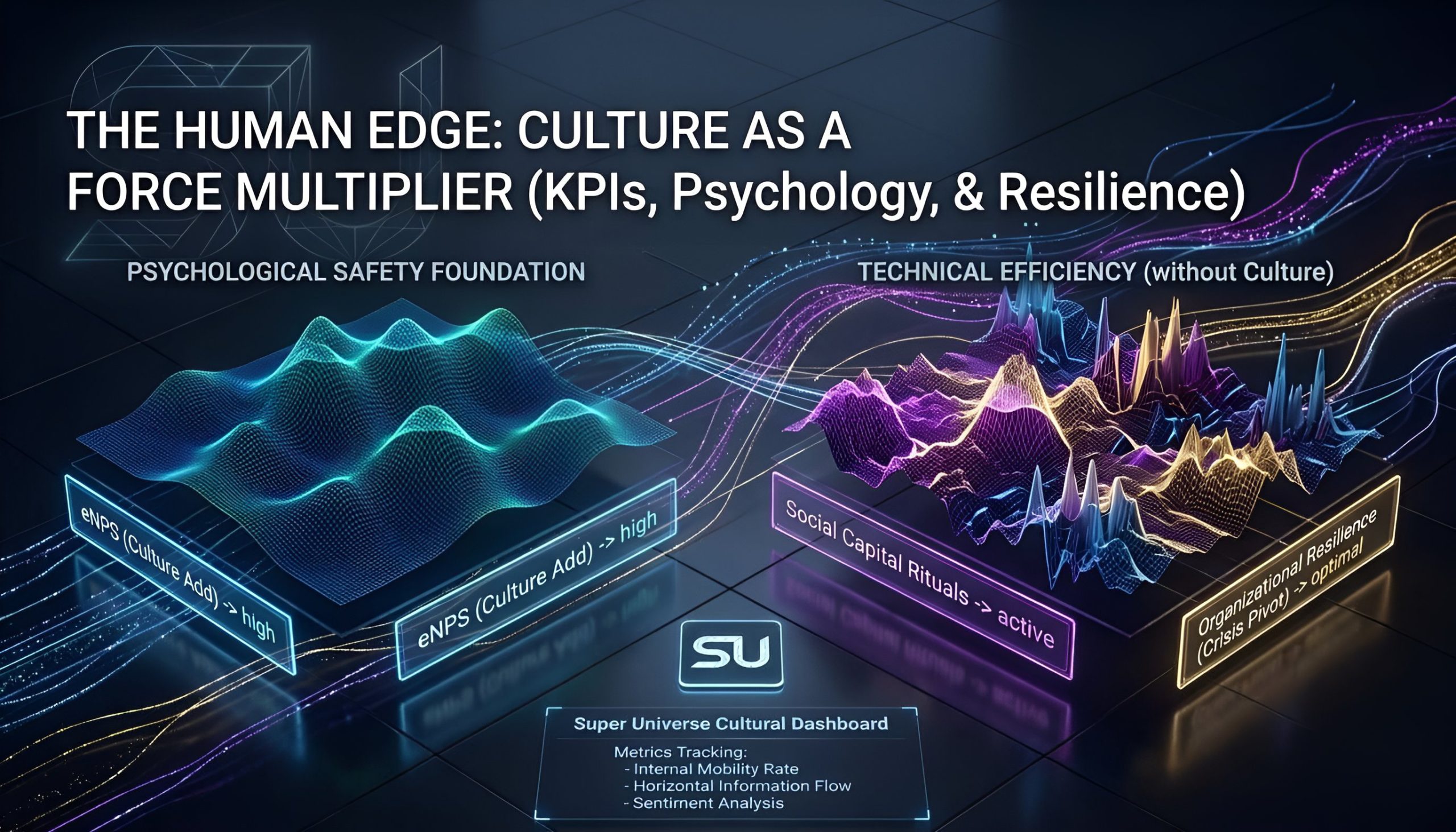
In the modern corporate world, we are obsessed with metrics. We track Key Performance Indicators (KPIs), analyze conversion rates, and optimize workflows using the latest technological frameworks. However, as organizations reach the limits of what pure technical efficiency can achieve, a fundamental truth is resurfacing: technology is a commodity, but culture is a differentiator. While two competing firms can buy the same software, hire from the same talent pool, and use the same hardware, their outputs will differ wildly based on the invisible social fabric that binds their people together. This is the “Human Edge”—the realization that a high-functioning culture acts as a force multiplier, turning individual effort into exponential collective performance.
Moving Beyond Culture as a “Soft” Concept
For too long, corporate culture was relegated to the “soft” side of business—something managed by HR through occasional team-building retreats or office perks. In 2026, we recognize that culture is actually the “hardest” part of an organization to build and the most difficult to replicate. It is the operating system of the human element.
If strategy is the map of where a company wants to go, culture is the engine that determines how fast and how reliably it can get there. A brilliant strategy executed in a toxic culture will eventually stall due to friction, turnover, and internal politics. Conversely, a mediocre strategy executed in a world-class culture will often succeed because the people involved are empowered to iterate, adapt, and solve problems in real-time.
The Psychological Safety Foundation
The primary mechanism by which culture multiplies performance is through “Psychological Safety.” This concept, popularized by decades of organizational research, describes a climate where team members feel safe to take risks, admit mistakes, and voice dissenting opinions without fear of retribution.
In a low-safety culture, employees spend a significant portion of their “cognitive bandwidth” on self-protection. They over-edit their emails, withhold innovative ideas to avoid potential embarrassment, and hide errors to protect their job security. This is a massive drain on productivity. When a culture prioritizes psychological safety, that bandwidth is reclaimed. People collaborate more freely, report problems earlier when they are cheaper to fix, and contribute “latent” ideas that often lead to the next big breakthrough. Performance is multiplied simply because the “tax” of fear has been removed.
Alignment vs. Autonomy: The Cultural Paradox
One of the greatest challenges for any growing organization is maintaining speed as complexity increases. Traditional management relies on “control”—rigid hierarchies and strict approval processes. However, control is a bottleneck. High-performance cultures solve this through a combination of high alignment and high autonomy.
When a culture is strong, every employee understands the “why” behind the company’s mission. This shared sense of purpose provides a “North Star” that allows leadership to grant deep autonomy. Employees don’t need to be told exactly how to do their jobs; they understand the desired outcome and the ethical guardrails, and they use their own ingenuity to get there. This creates a distributed decision-making network that is far faster and more resilient than any centralized command structure.
The Role of Shared Rituals and Language
Culture is not defined by what is written in the employee handbook; it is defined by what people do when no one is watching. This is reinforced through rituals and shared language. These elements serve as “cultural shorthand,” allowing teams to communicate complex values quickly and consistently.
Whether it is a specific way of conducting post-mortem meetings, a unique vocabulary for discussing customer needs, or a tradition of celebrating small wins, these rituals build social capital. They create a sense of belonging that transcends the purely transactional nature of work. In an era where remote and hybrid work have become the norm, these cultural anchors are what prevent an organization from dissolving into a collection of isolated freelancers.
Culture as a Recruitment and Retention Engine
In the “Reskilling War,” the most talented individuals have more choices than ever before. While competitive salaries and benefits are necessary to enter the conversation, they are rarely enough to keep the best people long-term. Top-tier talent is attracted to environments where they can do their best work, feel valued, and grow.
A strong culture acts as a natural filter. It attracts “culture adds”—people who share the core values but bring diverse perspectives—and naturally repels those who would be toxic to the environment. This reduces the immense costs associated with “bad hires” and high turnover. When employees feel a deep connection to their workplace culture, they become brand advocates, making recruitment an organic process rather than a constant uphill battle.
The Multiplier Effect on Innovation
Innovation is inherently messy. It requires a willingness to fail, a curiosity to explore dead ends, and the ability to cross-pollinate ideas from different departments. A performance-multiplying culture facilitates this by breaking down silos.
In a culture of high performance, information flows horizontally. A designer feels comfortable reaching out to a data scientist; a junior salesperson feels empowered to suggest a product feature to an engineer. This “intellectual friction” is where innovation happens. Without a supportive culture, these interactions are rare, and innovation remains confined to specific “innovation labs” that are often disconnected from the reality of the business.
Sustaining High Performance During Crisis
The true test of a culture is not how it functions during a bull market, but how it holds up under pressure. When a crisis hits—be it a market crash, a PR scandal, or a global disruption—organizations with a weak culture fracture. People look for someone to blame, protect their own interests, and become paralyzed by uncertainty.
In contrast, a high-performance culture tightens its bonds during a crisis. Because there is already a foundation of trust and shared purpose, the organization can pivot with incredible speed. Employees are willing to go the extra mile because they believe in the collective “we” rather than just the individual “me.” In this sense, culture is the ultimate form of organizational resilience.
The Leadership Mirror
Culture is a reflection of leadership behavior. It cannot be “delegated” to HR or “installed” via a consulting firm. Every action taken by a leader—who they promote, how they react to failure, what they praise, and what they tolerate—sends a signal that shapes the culture.
To multiply performance, leaders must move from “directing” to “stewarding.” This involves actively listening, modeling vulnerability, and consistently demonstrating the values they wish to see in the workforce. When leaders act as the guardians of the culture, they create an environment where performance is not coerced, but inspired.
Measuring the Unmeasurable
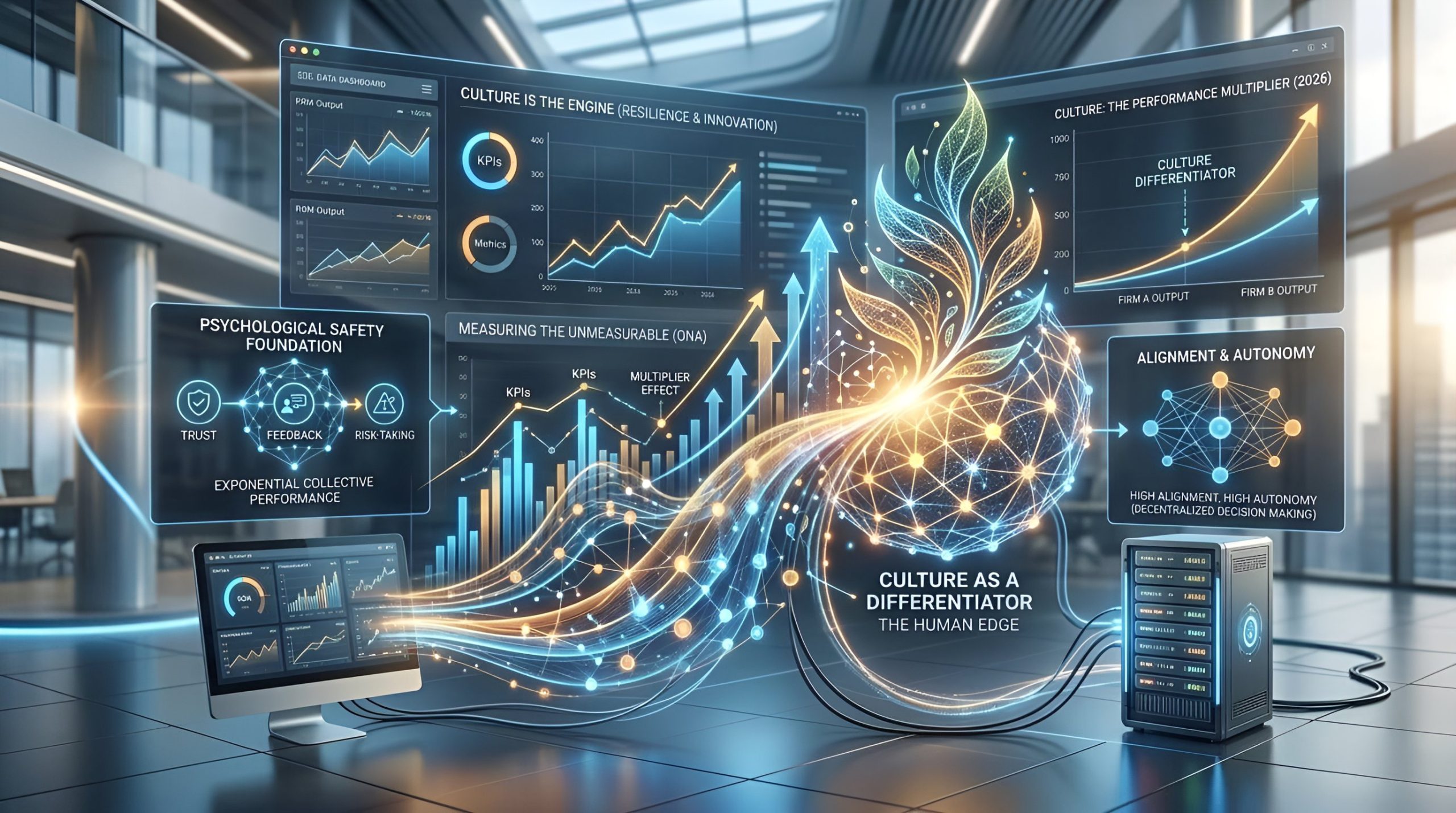
While culture is qualitative, its effects are highly quantitative. Forward-thinking companies are now using “Organizational Network Analysis” (ONA) and sentiment tracking to measure the health of their culture in real-time. They look at metrics such as:
-
Employee Net Promoter Scores (eNPS): How likely are employees to recommend the company?
-
Internal Mobility Rates: Are people growing within the cultural framework?
-
Social Connectivity: How well are different teams communicating without formal intervention?
By treating culture with the same analytical rigor as a financial balance sheet, organizations can identify cultural “dead zones” and intervene before they impact the bottom line.
Conclusion: The Sustainable Competitive Advantage
As we look toward the future of work, it is clear that the “Human Edge” is the only sustainable competitive advantage. Competitors can steal your ideas, poach your customers, and mirror your tech stack, but they cannot replicate your culture. It is a unique, organic, and evolving asset that belongs only to your organization.
When culture is treated as a performance multiplier, it transforms the workplace from a site of labor into a site of human flourishing. It creates a virtuous cycle where high performance leads to higher engagement, which in turn leads to even higher performance. In a world of increasing automation and fragmentation, the companies that prioritize the human spirit will be the ones that ultimately lead the way. Culture is not just “how we do things around here”—it is the very reason why we succeed.