


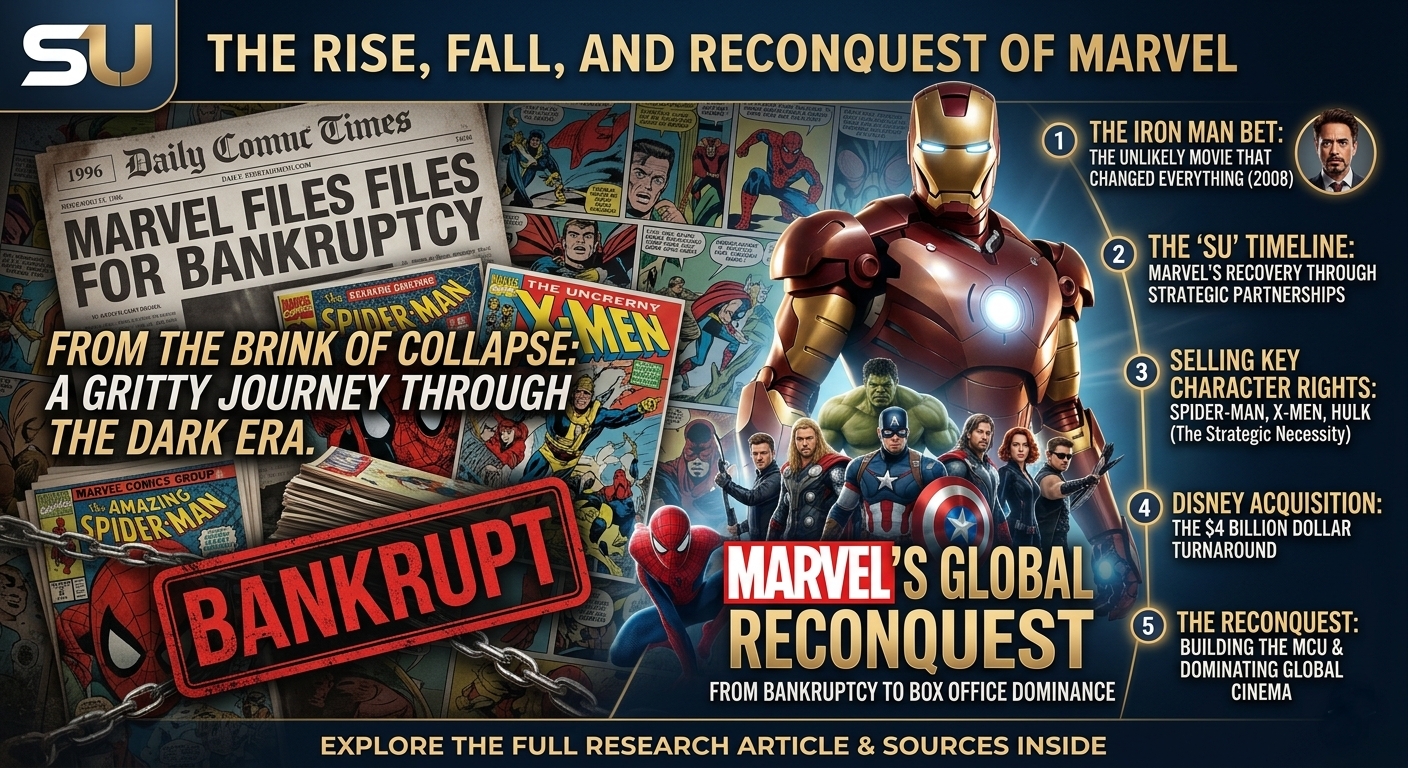

The History of Marvel’s Global Conquest from Bankruptcy
If you are a movie lover, you must have heard the name of the Marvel Cinematic Universe (MCU) and watched at least one movie. Their amazing VFX, flawless CGI, and perfect storytelling are extraordinary. But at one time, they claimed themselves bankrupt and became destitute, and today they are dominating the entire cinema world. Marvel Comics’ journey began in 1939 as ‘Timely Publications‘. But today we will not discuss Marvel’s journey; our discussion today will be about their dark time in the 1990s when Marvel almost lost its existence.
1. The beginning of the downfall through the ‘Comic Book Bubble’
In the early 1990s, the popularity of the comic book industry was sky-high. Todd McFarlane’s ‘Spider-Man #1‘ or Jim Lee’s ‘X-Men #1‘ were selling millions of copies. At that exact time, Marvel played a trick. They started releasing 5-10 different variant covers for the same comic. Collectors began to think that these comics could be sold for thousands of dollars in the future.
But around 1993, this artificial demand burst like a bubble. Comic fans got annoyed seeing so many variations and reduced buying comic books. Suddenly, the comic market dropped by 70%. Then Marvel realized that they were not just selling paper but were standing on a collapsing market.
2. Ronald Perelman’s wrong business policy
One of America’s billionaires, Ronald Perelman, bought Marvel in 1989. He wanted to see Marvel as a commercial brand more than a comic book company. He took loans at high interest rates and bought the following companies:
-
Panini: A company that makes stickers and collectibles.
-
SkyBox & Fleer: Trading card companies.
-
Heroes World Distribution: Marvel then tried to create their own distribution channel, which was the biggest mistake. Because of this, retailers lost trust in Marvel.
Ronald’s goal was to make Marvel a giant studio like Disney or Warner Bros, but the burden of debt took everything away from him. On December 27, 1996, Marvel officially filed for bankruptcy.
3. Selling characters to save life

To survive bankruptcy, Marvel then started selling the movie rights of their most valuable assets, the superheroes, at throwaway prices. And this was their only way to survive.
-
Spider-Man and Sony Pictures Deal: Sony bought the rights to Spider-Man from Marvel in 1999 for only $7 million. The interesting thing is, Marvel offered Sony all their characters (Avengers, Black Panther) for only $25 million. But Sony rejected it because they said no one really knows the other characters, they only need Spider-Man.
-
Mutants and Fox Studio: The rights to X-Men and Fantastic Four were bought by 20th Century Fox. Fox made X-Men movies in their own style, gained huge popularity, and made profits. They created a big franchise from there. And they used to give Marvel only nominal credit.
-
Hulk: The solo movie distribution rights of one of the most popular characters in comics, Hulk, went to Universal Pictures. But the deal was such that if Universal did not make a Hulk movie within a certain time, the rights would return to Marvel. But there was a twist in this too. Although Marvel got back the production rights of the Hulk movie, the distribution rights remained with Universal. This means if Marvel makes a solo movie of Hulk, Universal will get a large share of the profit. For this reason, although Marvel made ‘The Incredible Hulk‘ in 2008, it was distributed by Universal. Even today, despite creating a huge franchise like the Marvel Cinematic Universe, Marvel does not make solo Hulk movies because of these distribution rights.
By selling these characters, Marvel got money temporarily, but they lost their cinematic future.
4. Marvel’s new turn
After exiting bankruptcy by selling rights, around 1997-98, they merged with the Toy Biz company. This was led by Isaac ‘Ike’ Perlmutter and Avi Arad. They realized that Marvel could never become something big by giving characters to other studios. On the other hand, the sky-high success of X-Men and Spider-Man movies in the early 2000s gave Marvel the courage to do something.
Kevin Feige, who is currently one of Marvel’s masterminds, took a bold plan in 2003. That was, from now on, Marvel would make movies themselves and provide their own funding.
5. A $500 million gamble
In 2005, Marvel signed a deal to take a huge loan of $525 million from Merrill Lynch bank. The conditions of this deal were extremely terrifying and complex. If Marvel could not return the money to the bank, the bank would take legal ownership of their remaining characters like Captain America, Avengers, Doctor Strange, etc. That is, one wrong movie meant Marvel’s journey would end at once.
6. Playing the Iron Man bet with RDJ
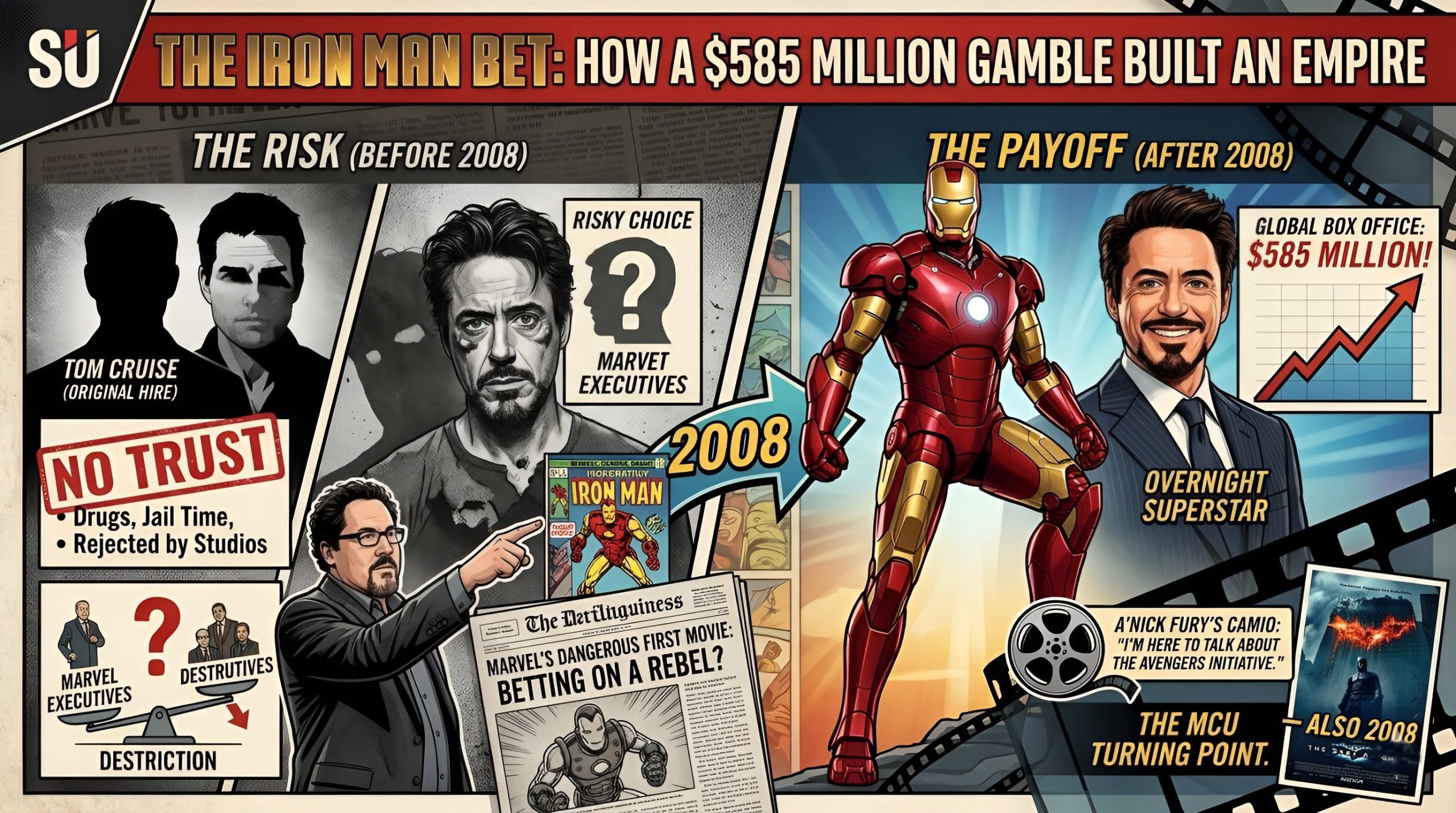
Marvel Studios chose Iron Man as their first movie. Although Iron Man was a moderately popular superhero in comics, he was completely new and unfamiliar to general audiences.
Marvel first hired Tom Cruise for this role. But director Jon Favreau said he would work only if Robert Downey Jr. played the role of Iron Man. But Downey was going through a very bad time then. No one was trusting him because of drugs and jail time. He was being rejected from various movies. Similarly, Marvel also did not want to take a risk and be destroyed in this difficult time. But due to Jon Favreau’s insistence, Downey finally got the role. Because he knew that the gap in the role of Tony Stark could only be filled by RDJ.
Iron Man was released in 2008. Interestingly, many people thought Batman had been released, although Batman’s ‘The Dark Knight‘ was also released that year. But Marvel hit the jackpot with the first movie. Iron Man (2008) earned a huge figure of $585 million worldwide and Downey became a superstar overnight. In the movie’s credit scene, Nick Fury appears, and from here Marvel gives hints of their cinematic universe. This is how Marvel took a turning point in the modern cinema world.
7. How Disney joins Marvel:
Seeing such incredible success of Marvel, Disney’s then-CEO Bob Iger realized that Marvel is a horse for a long race. Just the year after Iron Man’s release, in 2009, Disney bought Marvel for $4 billion. Many said at that time that Disney was making a mistake and called the price excessive. But Disney’s resources helped Marvel to move to a larger scale.
Marvel gradually recovers their sold characters:
-
Disney-Fox Deal: In 2019, Disney bought Fox Studios, and as a result, X-Men and Fantastic Four came under Marvel again.
-
Sony-Marvel Deal: A special deal was made with Sony to bring Spider-Man into the MCU.
8. Marvel’s recipe for success
There were several main reasons behind Marvel’s success:
-
Connected Universe: They created a thread from one movie to another, which no one had done on such a large scale before.
-
Kevin Feige’s intelligence and vision: As a comic book fan, Feige knew very well what fans want and when.
-
Humor: Marvel makes movies family-friendly and entertaining instead of making them monotonous.
9. Marvel, the Phoenix bird from the ashes
While everyone says Marvel lost everything by going bankrupt, I would say Marvel is in this position today because of being bankrupt. No one else has a franchise giant studio like Marvel now. Being bankrupt was a blessing for them, which I believe. Because if they hadn’t gone bankrupt, they might have been happy giving licenses to others forever. They have become one of the best studios in history because of taking risks in danger. Marvel, which was bankrupt in 1996, earned $2.79 billion with Avengers: Endgame in 2019. Can you imagine?
Sources for Further Reading:
-
Book: Comic Wars: How Two Tycoons Battled Over the Marvel Empire–And Both Lost — Dan Raviv.
-
Book: The Big Picture: The Fight for the Future of Movies — Ben Fritz (This contains details of the Sony and Marvel deal).
-
Report: Forbes: How Marvel Went From Bankruptcy To A $4 Billion Disney Acquisition.
-
Documentary: Marvel 75 Years: From Pulp to Pop! (Available on Disney+).
-
Archive: The New York Times (1996) – Marvel Comics Files for Bankruptcy.