


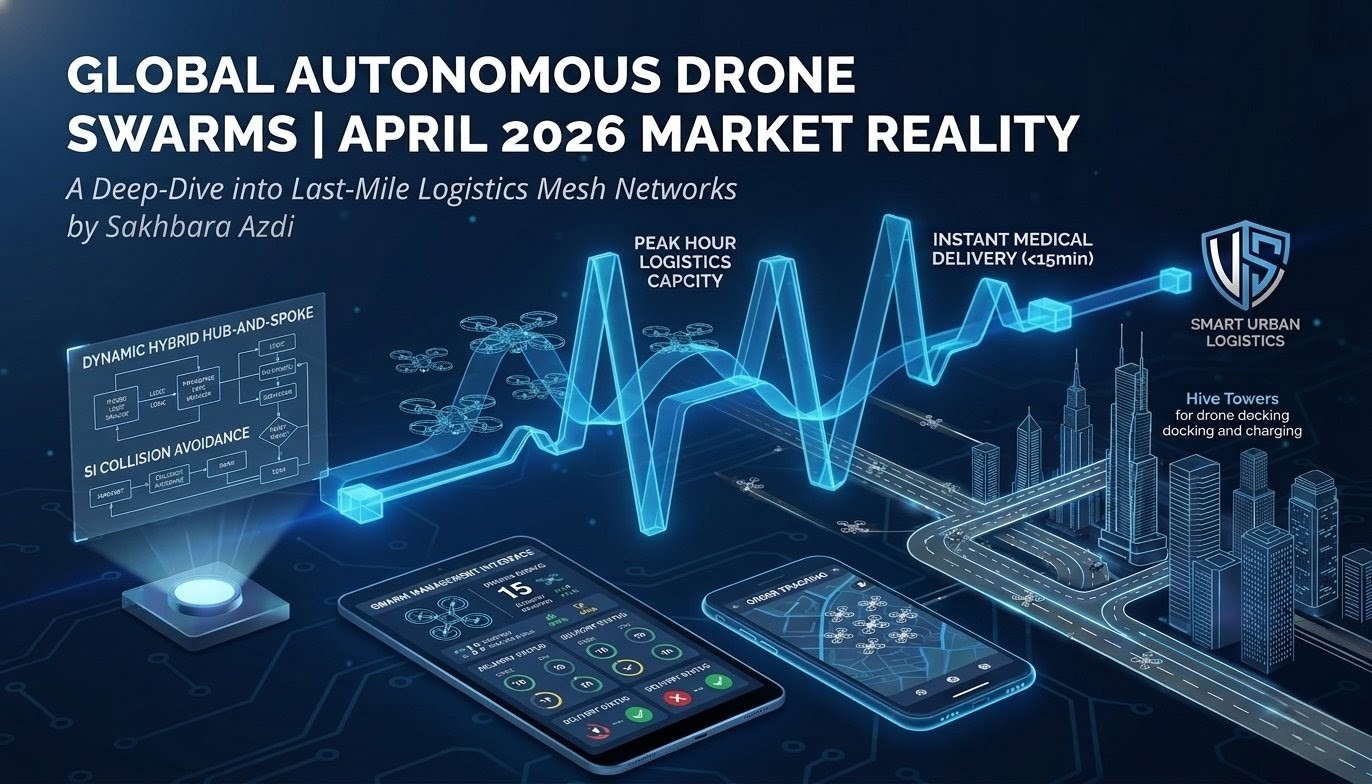

As of April 2026, the skyline of the world’s mega-cities has been fundamentally transformed. The “Last-Mile Delivery” problem—historically the most expensive, congested, and carbon-intensive segment of the supply chain—is no longer being solved by a fleet of idling diesel vans. Instead, the solution is airborne. Autonomous drone swarms have transitioned from experimental pilots into a multi-billion dollar logistical reality, projected to grow from $1.6 billion in 2026 to over $11.5 billion by 2035.
In cities like Shenzhen, Singapore, and New York, the “drone swarm” represents a paradigm shift in how we move goods. Unlike a single drone, which acts as a solitary messenger, a swarm operates as a decentralized, intelligent collective. This evolution in autonomous logistics is enabling sub-30-minute delivery for millions of urban residents, redefining the “Instant Economy.”
The Swarm Intelligence Advantage
The shift from individual drones to coordinated swarms in 2026 is driven by Swarm Intelligence (SI). This technology mimics biological collectives—like a flock of birds or a hive of bees—to manage complex maneuvers and obstacle avoidance in dense urban canyons.
-
Dynamic Task Allocation: In a 2026 logistical swarm, drones communicate via mesh networking. If one drone in the swarm is redirected to an urgent medical delivery (such as a surgical implant, a sector where drones have already cut delivery times by 70%), the rest of the swarm instantly recalculates their routes to ensure no other package is delayed.
-
Collision Avoidance and Resilience: Swarms in 2026 utilize onboard edge-computing flight-control units. This allows them to “sense and avoid” other aircraft, birds, and architectural features in real-time without needing to check back with a central server. If a single unit in the swarm fails, its “mission” is seamlessly absorbed by the nearest available drone.
-
Scalability: During peak hours—such as the lunch rush for food delivery—swarms can expand dynamically. Market leaders like Zipline and Amazon (the latter commanding a 15% market share in 2026) utilize these swarms to handle thousands of concurrent orders that would otherwise paralyze city streets.
The Economic Equation: $1.50 vs. $4.00
The primary driver for the adoption of drone swarms in 2026 is the staggering reduction in operational costs. Traditional human-driven last-mile delivery typically accounts for 53% of total logistics expenses.
Recent 2026 data shows that drone swarms have slashed the average cost per delivery to approximately $1.50, compared to $3.97 for an electric van and over $4.00 for a human driver. This 60-65% reduction in cost is forcing a massive reallocation of capital toward autonomous infrastructure. For the consumer, this translates to lower delivery fees and the normalization of “instant” gratification for small parcels (typically under 5 pounds), which make up the vast majority of e-commerce and restaurant orders.
The Hybrid Hub-and-Spoke Model
In the mega-cities of 2026, drones do not operate in a vacuum. They are the final “spoke” in a sophisticated Hybrid Autonomous Fleet.
-
Autonomous Trucks to Local Hubs: Large-capacity autonomous trucks or “dark store” feeders transport bulk shipments from regional warehouses to urban micro-hubs.
-
Swarm Deployment: Once at the local hub, drone swarms take over. These swarms are launched from “Hive Towers” or specially designed delivery vans that act as mobile landing pads and charging stations.
-
Final Drop-off: Drones utilize precision landing or hoist systems (like the DJI FlyCart 30) to deliver packages to balconies, designated drop-boxes, or even moving vehicles.
This model optimizes the 24/7 capacity of the logistics network. While traditional fleets are limited by driver fatigue and traffic hours, drone swarms operate with 99.9% uptime, doubling the daily capacity of urban delivery networks.
Overcoming the Mega-City Obstacles: Noise, Privacy, and Weather
Despite the rapid growth, 2026 has been a year of intense focus on the “Social License” for drone swarms. Mega-cities present unique challenges that are being addressed through engineering and regulation:
-
Acoustic Management: To combat “drone noise” complaints, 2026 models utilize bio-mimetic rotor designs and “silent propulsion” technologies that lower the decibel levels to a background hum, making them less intrusive than a standard city bus.
-
The Remote ID Mandate: As of January 1, 2026, global regulations require all drones to broadcast a Remote ID. This digital license plate allows authorities and citizens to identify drones in real-time, ensuring accountability and preventing “rogue” flights.
-
Weather Resilience: The 2026 generation of drones, such as the IP55-rated FC30, are designed to operate in temperatures ranging from -20°C to 45°C and can withstand winds up to 12 m/s. AI-driven routing now uses real-time micro-climate data to navigate around “urban wind tunnels” between skyscrapers.
Regulatory “Safe Havens” and Smart City Integration
The success of drone swarms in 2026 is largely due to the maturation of Smart Airspace Systems. Many mega-cities have established “Autonomous Corridors”—dedicated air-lanes that are digitally managed by centralized air traffic platforms.
The FAA in the U.S. and EASA in Europe have expanded BVLOS (Beyond Visual Line of Sight) permissions, allowing swarms to operate miles away from their controllers. This regulatory “green light” has enabled the expansion of “Fleet-as-a-Service” models, where local businesses can “rent” space in a drone swarm rather than owning their own fleet.
The Environmental Impact: The Green Last Mile
The transition to autonomous logistics is a cornerstone of the 2026 Sustainability Initiatives. Electric drone swarms produce zero tailpipe emissions, cutting the carbon footprint of a delivery by up to 84% per mile compared to traditional vehicles. In cities striving for “Net Zero” targets, the elimination of idling delivery trucks is the single most effective way to reduce urban CO2 and particulate matter.
The Future of the Urban Horizon
As we look toward 2030, the “Autonomous Logistics” mesh will only tighten. We are moving toward a world where the delivery of a package is as seamless and invisible as the flow of electricity. Drone swarms are not just a way to get a pizza delivered faster; they are the circulatory system of the 21st-century mega-city.
By 2026, we have proven that the sky is not a limit, but a highway. The drone swarm has successfully moved the “Last Mile” from the gridlocked streets to the open air, creating a logistics network that is faster, cheaper, and cleaner than anything that came before it.
As you navigate your own work-from-home schedule or manage your freelance projects, how would the ability to receive any tool or supply within 15 minutes change your approach to “just-in-time” productivity?