


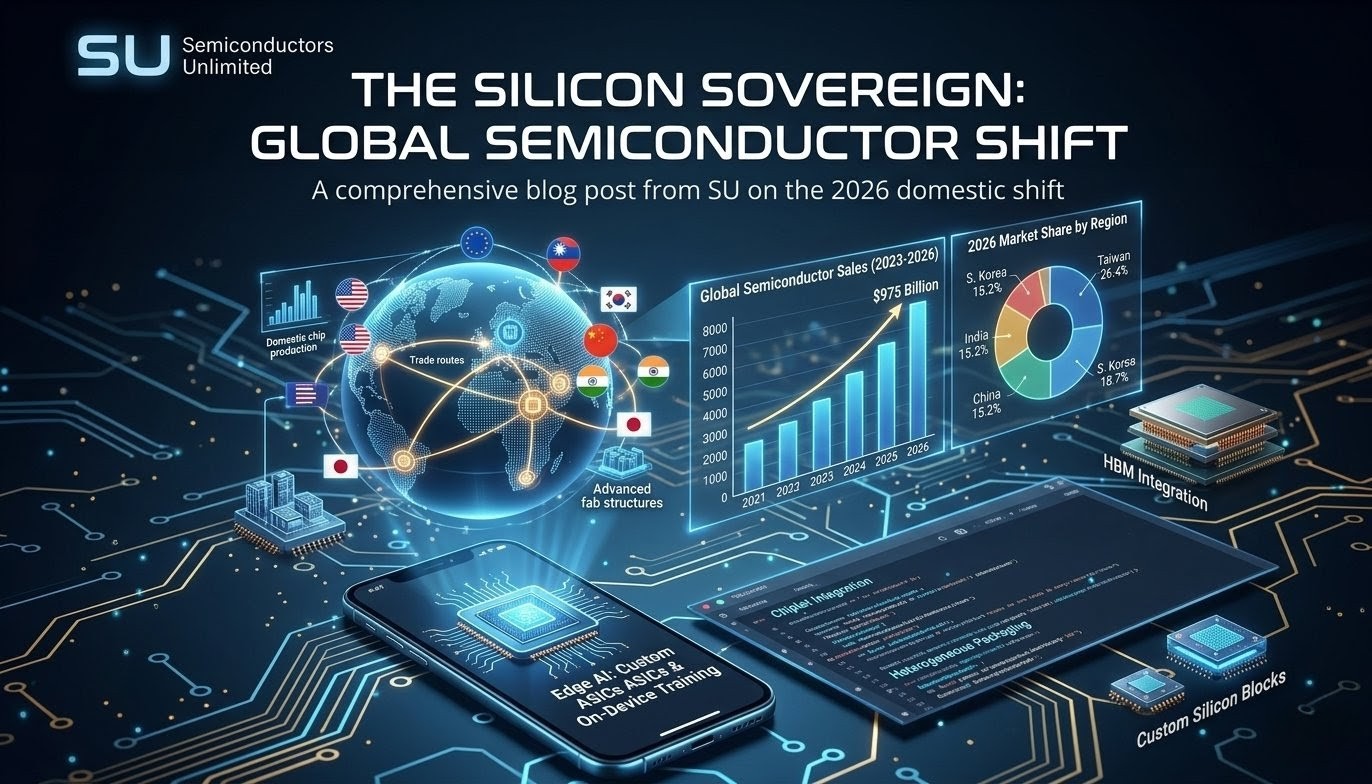

As of April 2026, the global semiconductor industry has reached a historic peak, with annual sales projected to hit $975 billion. However, the story of 2026 is not just about revenue; it is about the “Silicon Sovereign”—a fundamental geopolitical shift where nations have transitioned from a model of global interdependence to one of domestic technological sovereignty.
The realization that chips are the “new oil” has led to a massive reshuffling of the global supply chain. Governments are no longer content with being consumers of silicon; they are investing hundreds of billions of dollars to ensure they are the producers.
The New Geopolitical Map: 2026 Market Shares and Investment
The concentration of semiconductor manufacturing has long been a strategic vulnerability. In 2026, we see a diverse landscape of domestic initiatives aimed at breaking the “Taiwan bottleneck,” where one island still produces over 90% of the world’s most advanced chips.
| Region | 2026 Market Share | Major 2026 Initiative / Funding | Key Strategic Focus |
| Taiwan | 26.4% | $12B Domestic Expansion | Advanced Logic (<3nm), Foundries |
| South Korea | 18.7% | $450B “K-Belt” (by 2030) | Memory (HBM), Logic-Memory Integration |
| China | 15.2% | $143B Self-Sufficiency Fund | Mature Nodes, Legacy Chips, AI Hardware |
| United States | 12.8% | $52.7B CHIPS Act Allocation | AI Accelerators, R&D, Advanced Fabs |
| Japan | 8.9% | $25B “Rapidus” Project | Equipment, Materials, 2nm Foundry |
| European Union | 7.4% | $47B (EU Chips Act 2.0) | Automotive, Industrial, Power Semis |
| India | 1.8% | $10B “Tata Fab” Initiative | Design, Assembly, Testing (OSAT) |
The CHIPS Act 2.0 and “Technological Sovereignty”
By the second quarter of 2026, the original CHIPS acts of 2022 and 2023 have evolved. In March 2026, the European Commission introduced the “Revised Chips Act” (Chips Act 2.0). This update reflects a shift in priority: it is no longer just about building factories, but about securing the entire “value chain,” from raw materials to advanced packaging.
In the United States, the focus in 2026 has shifted to the “Foundry Renaissance.” Major facilities from Intel (Ohio), TSMC (Arizona), and Samsung (Texas) are nearing operational status. However, this domestic push has created a high-stakes paradox. While domestic capacity is increasing, the “Helium Crisis” and “Tungsten Bottlenecks” of early 2026 have proven that even a sovereign fab is useless without a secure, global supply of raw materials.
The Rise of Edge AI and Custom Silicon
A primary driver of the domestic shift in 2026 is the explosion of Edge AI. As we move away from centralized cloud computing toward on-device intelligence (as seen in the “AR Office” and “Autonomous Logistics”), the demand for specialized, custom silicon has skyrocketed.
-
The “General Purpose” Decline: Traditional, all-purpose CPUs and GPUs are losing ground to custom ASICs designed for specific AI workflows.
-
On-Device Training: 2026 marks the year where edge devices began performing “on-device training,” requiring chips that are not only powerful but extremely energy-efficient.
-
Heterogeneous Integration: Governments are prioritizing domestic capabilities in Chiplets and Die Stacking. By 2026, this “Lego-block” approach to chip design has become the preferred way to achieve high density without the impossible yields of monolithic 2nm wafers.
Supply Chain Decoupling and the “Regional Divergence”
The “Silicon Sovereign” movement has led to a significant regional divergence in the 2026 supply chain:
-
The High-End Hubs: The US, Taiwan, Japan, and Germany are specializing in “Front-End” manufacturing—the actual printing of circuits on silicon.
-
The Assembly Hubs: India and Southeast Asia (specifically Vietnam and Malaysia) have emerged as the dominant global centers for Back-End assembly, testing, and packaging (OSAT).
This decoupling is a double-edged sword. While it provides “Resilience” against a single point of failure, it has also led to 50% price spikes in essential components like memory (DRAM/NAND) due to the “High-Margin, Low-Volume” paradigm that domestic manufacturing often creates.
The Energy and Environmental Mandate
In 2026, a “Domestic Fab” is not just a strategic asset; it is a massive energy liability. Semiconductor facilities are now being evaluated on their Energy and Material Efficiency.
Foundries in 2026 are increasingly adopting “Circular Design Principles,” recycling over 90% of their water and utilizing onsite renewable energy to mitigate the strain on local power grids. For many nations, the limit on “Silicon Sovereignty” is no longer the amount of money they can print, but the amount of electricity they can generate.
The Future of Global Trade
As we look toward the end of 2026, the “Global Shift” has permanently altered the nature of trade. We have moved from a “Just-in-Time” global market to a “Just-in-Case” domestic one. The semiconductor industry is now the heart of “Economic Security.”
Nations that have successfully built their own “Silicon Sovereign” are seeing a massive “Multiplier Effect”—for every direct job in a semiconductor fab, up to five indirect jobs are created in the wider tech ecosystem. The chips of 2026 are more than just components; they are the fundamental building blocks of national identity and economic survival in a post-globalized world.
As a freelancer or student in 2026, how does this “domestic” shift in tech production impact your view on the hardware you buy? Does the “Made in [Your Country]” label on a chip matter to you as much as its performance?