


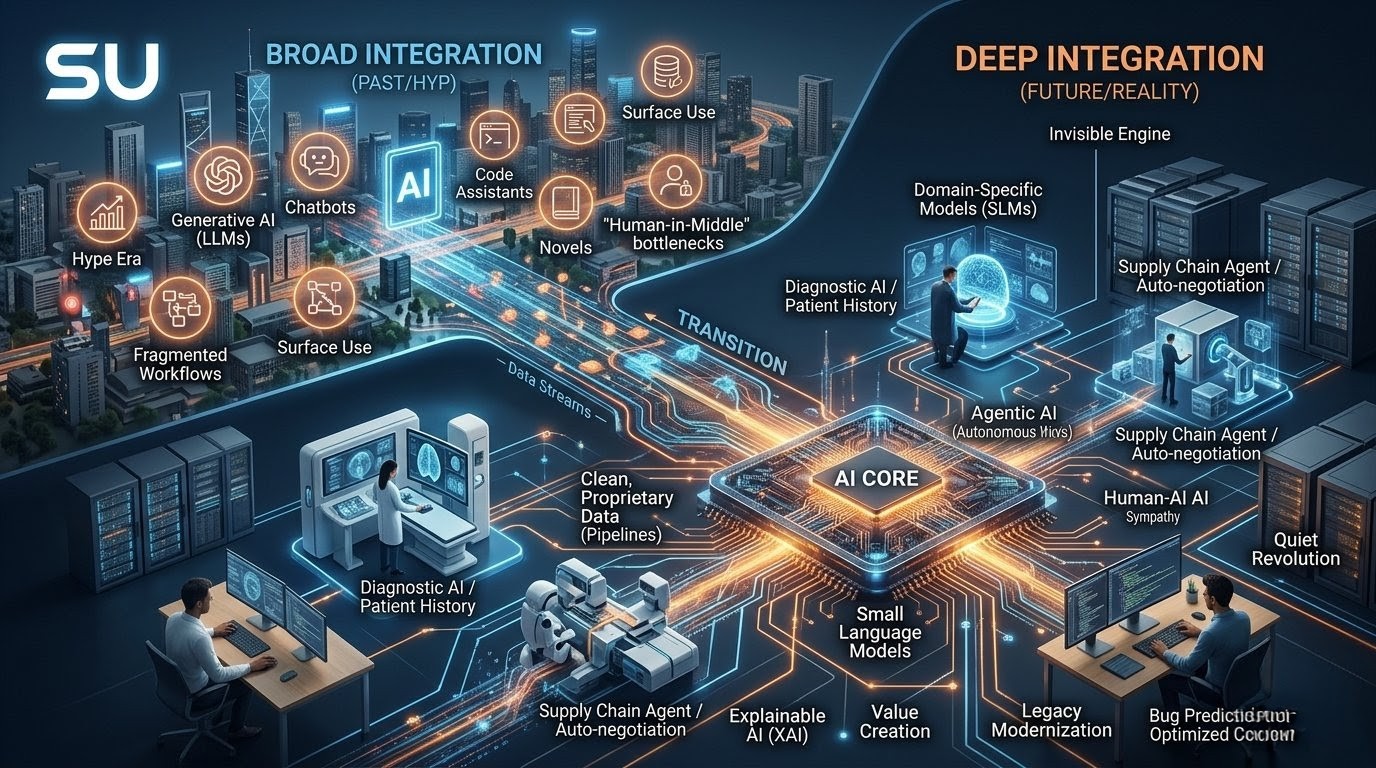

The initial fervor surrounding artificial intelligence has reached a critical turning point. For the past few years, the global conversation has been dominated by the “wow factor” of generative models, large language models, and the sudden accessibility of automation tools. We have lived through the era of broad integration—a phase characterized by experimentation, curiosity, and the rapid, sometimes haphazard, adoption of AI across various sectors. However, as the novelty begins to fade, a more significant and complex challenge emerges: deep integration. This is the transition from using AI as a flashy peripheral tool to embedding it into the core architecture of how we solve problems, conduct business, and innovate.
The Limitations of Surface-Level AI Adoption
In the broad integration phase, AI was often treated like a digital Swiss Army knife. Businesses and individuals rushed to use chatbots for basic customer service, generated images for social media, or used AI to draft generic emails. While these applications provided immediate productivity gains, they remained largely on the surface. They were “add-ons” rather than “integrations.”
The limitation of this approach is that it often leads to fragmented workflows. When AI exists as a separate layer that users must manually interact with to get a result, it creates a “human-in-the-middle” bottleneck. Furthermore, broad integration often fails to account for the specific nuances of a particular industry or the unique data sets of a specific company. To move beyond the hype, we must stop asking what AI can do in general and start asking how AI can be architected into the very foundation of our specific professional domains.
Defining Deep Integration: The Structural Shift
Deep integration is defined by the seamless, invisible, and specialized application of machine learning and intelligent systems within a workflow. In this stage, AI is no longer an external destination; it is an internal engine. It involves moving away from general-purpose tools and toward highly specialized, “fine-tuned” models that understand the specific vocabulary, regulatory constraints, and historical context of a niche field.
For a medical professional, deep integration isn’t just using a chatbot to look up symptoms. It is a diagnostic system integrated into the imaging hardware that identifies anomalies in real-time with higher accuracy than the human eye, cross-referencing the patient’s entire genetic history and current medications. For a software engineer, it isn’t just a code-completion tool; it is an automated CI/CD pipeline that predicts where bugs will occur based on architectural patterns and suggests optimizations before a single line of code is committed to the main branch.
The Data Sovereignty and Quality Hurdle
The journey from broad to deep integration requires a massive shift in how we handle data. Broad AI thrives on the public internet—a vast, messy repository of general information. Deep AI, however, requires high-quality, structured, and proprietary data. This is where many organizations currently struggle.
Deep integration necessitates “data hygiene.” You cannot build a deep AI strategy on top of siloed, inconsistent, or “dirty” data. Organizations are now realizing that their AI strategy is, in reality, a data strategy. To achieve depth, companies must invest in robust data pipelines that ensure information is accurate, labeled correctly, and updated in real-time. This also brings the issue of data sovereignty to the forefront. As AI moves deeper into the core of the business, the need to keep that data private and secure becomes paramount, leading to the rise of localized, on-premise, or private-cloud AI environments.
Moving from Generative to Agentic AI
One of the most exciting aspects of moving toward deep integration is the shift from “Generative AI” to “Agentic AI.” Generative AI requires a prompt and provides a response. Agentic AI, on the other hand, is given a goal and determines the steps necessary to achieve it.
In a deep integration model, these AI agents work autonomously within set guardrails. For example, in supply chain management, an agentic system doesn’t just warn a manager that a shipment is delayed. It identifies the delay, calculates the impact on production, autonomously contacts alternative suppliers, negotiates pricing based on pre-set budgets, and re-routes the logistics—all while keeping the human supervisor informed of the final outcome. This level of autonomy is the hallmark of deep integration, moving from AI as a consultant to AI as a collaborator.
The Importance of Domain-Specific Models
We are witnessing the decline of the “one model to rule them all” philosophy. While massive foundation models are impressive, they are often “jacks of all trades and masters of none.” The next phase of AI evolution belongs to Small Language Models (SLMs) and domain-specific architectures.
Deep integration relies on models that have been trained or fine-tuned on specialized datasets—legal documents, engineering blueprints, architectural codes, or financial ledgers. These specialized models are more efficient, less prone to “hallucinations” within their field, and significantly cheaper to run. By narrowing the scope, we increase the depth of utility. A model that only knows about structural engineering is far more valuable to a builder than a model that knows everything about the world but only the basics of physics.
Human-AI Sympathy: The New Design Paradigm
A common misconception is that deep integration means total automation and the removal of the human element. In reality, the deepest integrations are those that enhance human capability. This requires a new approach to User Interface (UI) and User Experience (UX) design.
Instead of a “chat box,” deep integration might look like “ambient intelligence.” It is the software that subtly highlights a potential error in a spreadsheet, the steering wheel that vibrates when a driver’s attention wanders, or the retail system that suggests a personalized discount to a customer based on their physical journey through a store. The goal is to reduce the cognitive load on the human, allowing them to focus on high-level decision-making while the AI handles the complex background processing.
Overcoming the “Black Box” Problem
As AI integrates more deeply into critical systems, the “Black Box” problem—the inability to see how an AI reached a specific conclusion—becomes a major liability. Deep integration requires “Explainable AI” (XAI). In sectors like finance, healthcare, and law, it is not enough for an AI to be right; it must be able to show its work.
Moving beyond the hype means building transparency into the system. This involves creating audit trails for AI decisions and ensuring that there is always a “human-in-the-loop” for high-stakes outcomes. Depth without accountability is a recipe for systemic failure. Therefore, the transition to deep integration must be accompanied by a robust ethical framework and clear regulatory compliance.
The Economic Shift: From Cost-Saving to Value-Creation
The broad integration phase was largely driven by a desire for efficiency and cost-cutting—doing the same things, just faster and cheaper. Deep integration, however, is about value creation—doing things that were previously impossible.
In the world of drug discovery, deep AI integration allows researchers to simulate millions of molecular interactions in days, leading to the creation of medicines that a human team could never have conceptualized. In climate science, it allows for hyper-local weather modeling that can save entire harvests. This shift from “saving” to “creating” is what will ultimately justify the massive investments being made in AI technology.
The Challenges of Legacy Systems
One of the greatest hurdles to deep integration is the existence of legacy infrastructure. Many established industries operate on software and hardware that were never designed to handle the data requirements of modern AI.
Moving beyond the hype requires a painful but necessary period of modernization. This often means moving away from “monolithic” software architecture toward “modular” or “microservices” architectures that can easily ingest and interact with AI components. For many organizations, the “Reskilling War” mentioned in previous discussions is closely tied to this: they need people who understand how to bridge the gap between old-world systems and new-world intelligence.
The Cultural Resistance to Depth
Deep integration is inherently disruptive. It changes job descriptions, shifts power dynamics within organizations, and requires a level of trust in technology that many are not yet comfortable with. Broad integration was easy to accept because it was optional and superficial. Deep integration is structural and mandatory.
To succeed, leaders must manage the “fear factor.” This involves clear communication about how AI will augment rather than replace roles, and providing the necessary training to ensure that the workforce feels empowered by the new tools. A culture that views AI as a threat will only ever achieve surface-level adoption. A culture that views it as an evolution will achieve the depth necessary to survive in a competitive landscape.
Conclusion: The Quiet Revolution
The era of AI hype was loud, filled with bold claims and viral demonstrations. The era of deep integration will be much quieter. It will be characterized by the steady, methodical improvement of every system we use. We will stop talking about “using AI” and simply start talking about “doing work,” because the AI will be as fundamental to the process as electricity or the internet.
Moving from broad to deep integration is the difference between a novelty and a utility. It is the hard work of turning a breakthrough into a backbone. For those willing to navigate the complexities of data, ethics, and infrastructure, the rewards will be a level of capability and innovation that was once the stuff of science fiction. The hype has set the stage, but the deep integration will build the future.