


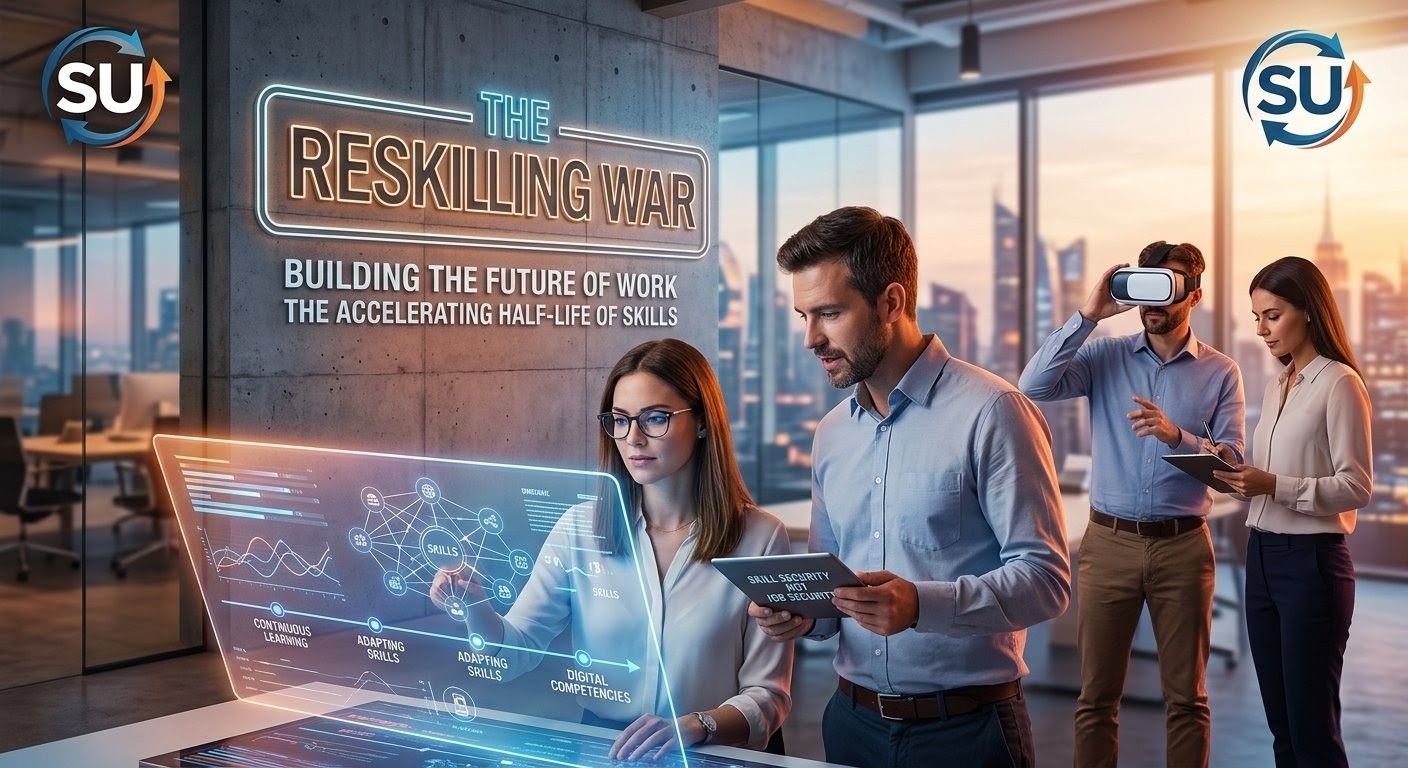

The global workforce is currently navigating a period of unprecedented transition. While the concept of learning on the job has existed for centuries, it has evolved from a passive benefit into a high-stakes survival mechanism. We are no longer in an era where a single degree or a specific set of vocational skills can sustain a forty-year career. Instead, we have entered what economists and HR visionaries call the “Reskilling War.” This is a fundamental shift in how companies view human capital and how individuals manage their professional identities. As automation, artificial intelligence, and shifting global markets redefine what “work” looks like, the ability to learn, unlearn, and relearn has become the primary competitive advantage for both the employer and the employee.
The Accelerating Half-Life of Skills
One of the most pressing drivers of the reskilling war is the shrinking half-life of professional skills. In the mid-20th century, a skill learned in a trade school or university could remain relevant for nearly thirty years. Today, that window has collapsed to approximately five years, and in technical fields, it is often less than two. This rapid obsolescence means that by the time a student completes a four-year degree, some of the specific technical methodologies they mastered during their freshman year may already be outdated.
This reality has created a massive skills gap. Companies often find themselves with thousands of employees who are dedicated and understand the corporate culture, yet lack the specific technical or digital competencies required to drive the business forward in a modern context. Replacing these workers is not only expensive but often impossible, as the external talent market is equally drained. Therefore, the only logical solution is to build talent from within, transforming the workplace into a continuous classroom.
Why Hiring Externally is no Longer Enough
For decades, the standard response to a talent shortage was to “buy” rather than “build.” If a company needed data scientists or cloud architects, they simply posted a job opening and offered a higher salary than the competition. However, this strategy is failing in the current climate for several reasons. First, the cost of hiring a new employee—including recruitment fees, onboarding, and the loss of productivity during the transition—is significantly higher than the cost of upskilling an existing staff member.
Furthermore, the talent pool for emerging technologies is shallow. There are simply not enough qualified candidates graduating from traditional institutions to fill the demand. This scarcity has led to a “bidding war” for talent that is unsustainable for most small to mid-sized enterprises. By focusing on continuous learning, organizations can tap into the hidden potential of their current workforce, leveraging their institutional knowledge while layering on the modern skills necessary for the digital age.
The Psychological Shift: Moving from Job Security to Skill Security
The reskilling war is not just a corporate logistical challenge; it is a psychological one for the workforce. The old social contract suggested that loyalty and steady performance guaranteed job security. That contract is effectively void. In its place is a new paradigm: skill security.
Modern professionals are beginning to realize that their value is not tied to their current job title, but to their ability to adapt. This shift requires a growth mindset—a belief that intelligence and abilities can be developed through dedication and hard work. Employees who embrace continuous learning are finding themselves more resilient to market fluctuations. They are the ones who view a new software rollout or a shift in departmental goals not as a threat, but as an opportunity to expand their personal portfolio of competencies.
The Role of Artificial Intelligence as a Catalyst
We cannot discuss the reskilling war without addressing the role of Artificial Intelligence (AI). Unlike previous industrial revolutions that primarily automated manual labor, the current wave of AI is impacting cognitive tasks. Roles in marketing, legal services, coding, and administrative management are being fundamentally altered.
However, the most successful professionals are not those trying to compete with AI, but those learning to collaborate with it. Reskilling in this context often means moving away from rote, repetitive data processing and toward high-level strategy, ethics, and creative problem-solving. It involves learning how to prompt, audit, and integrate AI tools into daily workflows. The “war” is won by those who can use technology to amplify their human strengths, such as empathy, critical thinking, and complex communication.
Building a Culture of Lifelong Learning
For a reskilling strategy to be effective, it cannot be a one-time workshop or a mandatory HR video series. It must be woven into the fabric of the company culture. This means moving toward “micro-learning”—short, focused bursts of educational content that employees can consume during their workday. It also involves “social learning,” where peers teach one another through collaborative projects and internal mentorship programs.
Leaders must also incentivize learning. If an employee takes the initiative to master a new language, a new coding framework, or a new project management methodology, that effort should be recognized in their performance reviews and career progression. When learning is tied to tangible rewards, the workforce becomes self-motivated to stay ahead of the curve.
The Economic Impact of the Skills Gap
From a macro perspective, the failure to reskill the global workforce carries a heavy price tag. Trillions of dollars in potential GDP are lost because companies cannot find the talent needed to innovate. This creates a drag on national economies and exacerbates income inequality. Those who have access to high-quality continuous learning thrive, while those stuck in stagnant roles fall further behind.
Governments and educational institutions are starting to realize they must play a role in the reskilling war. We are seeing a rise in public-private partnerships designed to create “boot camps” and vocational tracks that are more agile than traditional four-year degrees. These programs focus on immediate, high-demand skills, providing a fast track for workers who need to pivot their careers quickly.
Soft Skills: The Unexpected Frontier of Reskilling
While technical skills like data analytics and cybersecurity often get the most attention, the reskilling war is also being fought on the front of “soft skills” or “durable skills.” As machines take over the technical heavy lifting, human-centric abilities are becoming more valuable, not less.
Leadership, emotional intelligence, negotiation, and cross-cultural collaboration are skills that do not have an expiration date. Interestingly, many professionals who have spent their careers in technical roles are now being “reskilled” to improve their communication and management abilities. The goal is to create “T-shaped” individuals: those who have deep expertise in one specific area but also possess a broad set of interpersonal skills that allow them to work effectively across an entire organization.
The Individual’s Responsibility in the New Talent Strategy
While companies must provide the resources, the ultimate responsibility for reskilling lies with the individual. In the modern economy, every professional is essentially the CEO of their own career. This requires a proactive approach to professional development.
This might include:
-
Dedication to “Learning Hours”: Setting aside specific time each week to read industry journals, take online courses, or experiment with new tools.
-
Seeking Feedback: Actively asking for critiques to identify blind spots in one’s current skill set.
-
Networking Outside the Silo: Engaging with professionals in different industries to understand how broader trends might eventually impact your specific field.
Overcoming the Barriers to Continuous Learning
The path to a reskilled workforce is not without obstacles. The most significant barrier is often time. Many employees feel overwhelmed by their daily responsibilities and view additional learning as a burden rather than a benefit. To combat this, organizations must allow for “learning in the flow of work,” ensuring that development is not something that happens after work, but is a core part of the job description.
Another barrier is the fear of failure. Learning something new often involves a period of incompetence, which can be bruising for senior professionals who are used to being experts. A healthy talent strategy creates a “psychologically safe” environment where making mistakes during the learning process is encouraged and supported.
The Future of the Talent Strategy
Looking ahead, the reskilling war will likely lead to more personalized career paths. Instead of linear ladders, we will see “career lattices” where employees move laterally across different departments to gain a diverse range of experiences. We may also see the rise of “skill passports”—digital credentials that provide a verifiable and portable record of an individual’s competencies, making it easier for them to navigate the internal and external job markets.
The companies that win the reskilling war will be those that view their employees as renewable resources rather than disposable assets. By investing in the intellectual growth of their people, they build a workforce that is not only more capable but also more loyal and engaged. In a world of constant change, the only true stability is the ability to learn.
Conclusion: Embracing the Perpetual Beta
The “Reskilling War” is not a conflict with a definitive end date. It is a permanent shift in the human condition as it relates to productivity and labor. To thrive in this environment, both organizations and individuals must adopt a mindset of being in “perpetual beta”—always evolving, always improving, and never truly finished.
Continuous learning is the new talent strategy because it is the only one that acknowledges the reality of our time. It transforms the threat of technological displacement into a promise of human advancement. By prioritizing the development of new skills, we ensure that the future of work remains human-centric, innovative, and resilient. The war is on, and the most powerful weapon in the arsenal is an open mind and a commitment to lifelong education.