


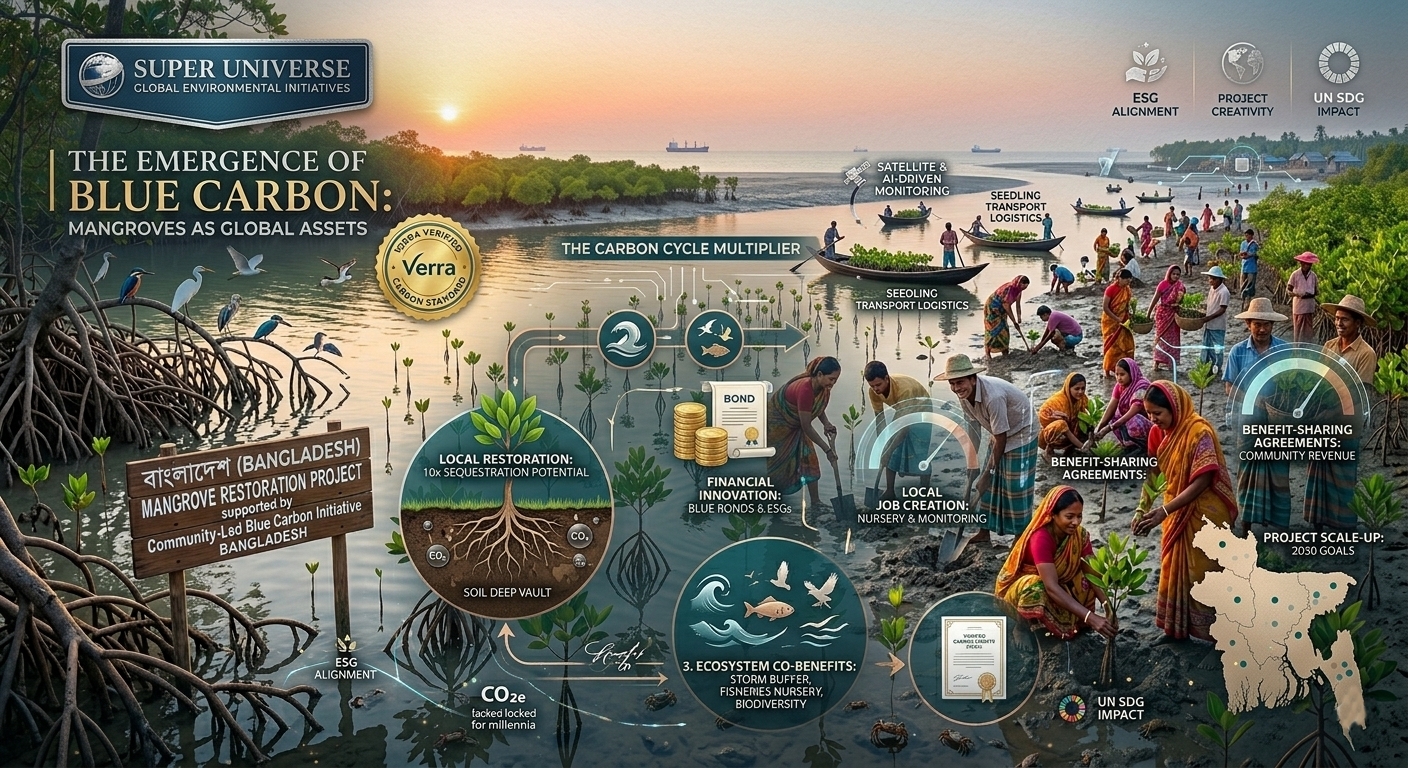

The Emergence of Blue Carbon in the Global Market
For decades, the conversation surrounding climate change and carbon sequestration centered almost exclusively on terrestrial forests. Vast expanses of the Amazon or the taiga of Siberia were viewed as the primary “lungs” of the planet. However, a new frontier has emerged in the fight against global warming, one that exists at the intersection of land and sea. Blue carbon—the carbon captured by the world’s ocean and coastal ecosystems—is rapidly moving from a scientific niche to a high-value asset class. At the heart of this movement is the mangrove tree, a hardy, salt-tolerant species that is proving to be one of the most efficient carbon-scrubbing machines on Earth.
Investors, governments, and corporations are now funneling billions of dollars into mangrove restoration projects. This isn’t just about corporate social responsibility or “greenwashing”; it is a calculated financial move. As the voluntary carbon market matures and the price per ton of carbon rises, coastal ecosystems are offering a return on investment that rivals traditional commodities. The “Blue Carbon Race” is officially on, and it is reshaping how we value the natural world.
Why Mangroves Are Carbon Super-Sequesterators
To understand why mangroves are the crown jewels of the blue carbon economy, one must look at the biology of these coastal sentinels. Unlike tropical rainforests, which store most of their carbon in their biomass (leaves, branches, and trunks), mangroves store the vast majority of their carbon in the soil. The waterlogged, anaerobic conditions of mangrove sediments prevent organic matter from decaying quickly. This allows carbon to be trapped and stored for centuries, or even millennia, rather than being released back into the atmosphere through decomposition.
Research indicates that mangroves can sequester up to four to ten times more carbon per acre than upland terrestrial forests. This density makes them incredibly efficient. For an investor looking to maximize carbon credits per hectare, mangroves provide a far better “yield” than almost any other ecosystem. Furthermore, the longevity of this storage provides the “permanence” that high-quality carbon credits require. When a mangrove forest is restored, the carbon isn’t just temporarily tucked away; it is effectively locked in a deep-sea vault.
The Financial Infrastructure of Coastal Restoration
The transition of mangrove restoration from a non-profit endeavor to an investment opportunity has been facilitated by the development of sophisticated financial instruments. Blue Bonds and specialized carbon offset programs have created a pathway for institutional capital to enter the space. In the past, restoration was funded by grants that were often inconsistent or short-term. Today, we are seeing the rise of “nature-based solutions” as a formal asset category.
These investments work by calculating the amount of carbon dioxide equivalent ($CO_{2}e$) that a specific restoration project will prevent from entering the atmosphere or will actively remove. These calculations are then verified by third-party standards such as Verra or the Gold Standard. Once verified, these credits can be sold on the voluntary carbon market to companies aiming to reach “Net Zero” goals. Because blue carbon is rarer and offers more co-benefits than traditional forest carbon, these credits often command a premium price, sometimes double or triple the cost of standard terrestrial credits.
The Multiplier Effect: Beyond Carbon Credits
What truly sets mangrove restoration apart as a “great investment” is the sheer volume of co-benefits, often referred to as “stacked wins.” Investors are increasingly looking at ESG (Environmental, Social, and Governance) metrics that go beyond simple carbon numbers. Mangroves provide a natural infrastructure that offers immense economic value in other areas.
First, there is coastal protection. Mangroves act as a living buffer against storm surges and rising sea levels. For coastal communities and nearby real estate or industrial assets, a healthy mangrove forest is a more cost-effective and durable defense than a concrete sea wall. Second, these ecosystems are vital nurseries for global fisheries. Approximately 75% of commercial fish species spend part of their life cycle in mangrove roots. By restoring these forests, investors are indirectly supporting the multi-billion dollar seafood industry. Finally, biodiversity credits are emerging as a secondary market, where companies pay to protect the unique species that inhabit these coastal zones.
Risk Management and the Challenges of Coastal Investment
No high-reward investment comes without risk, and the blue carbon market is no exception. Restoration projects are complex and require deep local expertise. One of the primary risks is “non-permanence”—the possibility that a storm or disease could destroy the restored forest, releasing the stored carbon and devaluing the credits. To mitigate this, project developers often maintain a “buffer pool” of credits that are never sold, acting as an insurance policy against natural disasters.
There is also the challenge of “leakage,” where protecting one area of mangroves might lead to deforestation in another. Furthermore, land tenure in coastal regions can be notoriously murky. For an investment to be viable, the legal rights to the land and the carbon it produces must be crystal clear. Investors are now utilizing satellite monitoring and AI-driven data analysis to track the health of mangrove projects in real-time, providing a level of transparency that was impossible a decade ago.
The Role of Local Communities in Scalable Success
For mangrove restoration to be a sustainable investment, it must move away from the “fortress conservation” models of the past. The most successful and profitable projects are those that integrate local communities as primary stakeholders. If a restoration project deprives local fishers of their livelihood, it is destined for failure. Conversely, if the project creates jobs in seedling nurseries, forest monitoring, and sustainable ecotourism, the local population becomes the forest’s greatest protector.
Many modern blue carbon contracts now include “benefit-sharing” agreements. These ensure that a significant percentage of the revenue from carbon credit sales goes directly back into local schools, healthcare, and infrastructure. This social stability reduces the risk for the investor and ensures the long-term viability of the project. It turns out that in the blue carbon race, social equity is a prerequisite for financial performance.
The Future Pipeline: Scaling the Blue Economy
As we look toward 2030 and beyond, the demand for high-quality blue carbon credits is expected to far outstrip supply. We are seeing the entry of major tech firms and global airlines into long-term purchase agreements, effectively “pre-ordering” carbon credits from mangrove projects that haven’t even been planted yet. This forward-funding is providing the upfront capital needed to launch massive, landscape-scale restoration efforts in Southeast Asia, Africa, and Latin America.
The “Great Investment” of mangrove restoration is also evolving through technology. Drones are being used to “seed” remote coastal areas, and blockchain technology is being utilized to track the provenance of every carbon credit, ensuring that there is no double-counting. We are moving toward a highly liquid, transparent market where “blue carbon” is as standard a part of a diversified portfolio as gold or real estate.
The Strategic Imperative for Modern Investors
The window for entering the blue carbon market at a ground-floor valuation is closing. As more countries include mangrove protection in their Nationally Determined Contributions (NDCs) under the Paris Agreement, the supply of available “unclaimed” coastal land for private investment will shrink. For the forward-thinking investor, mangroves represent a unique opportunity to hedge against climate risk while tapping into a high-growth market.
Ultimately, the Blue Carbon Race is a testament to a fundamental shift in global economics. We are finally beginning to price the services that nature provides for free. By treating a mangrove forest not as a wasteland to be cleared for shrimp farms, but as a high-performance carbon-capture facility, the global investment community is helping to ensure that these vital ecosystems remain a part of our coastal landscapes for generations to come. The financial return is clear, but the environmental return is immeasurable.