


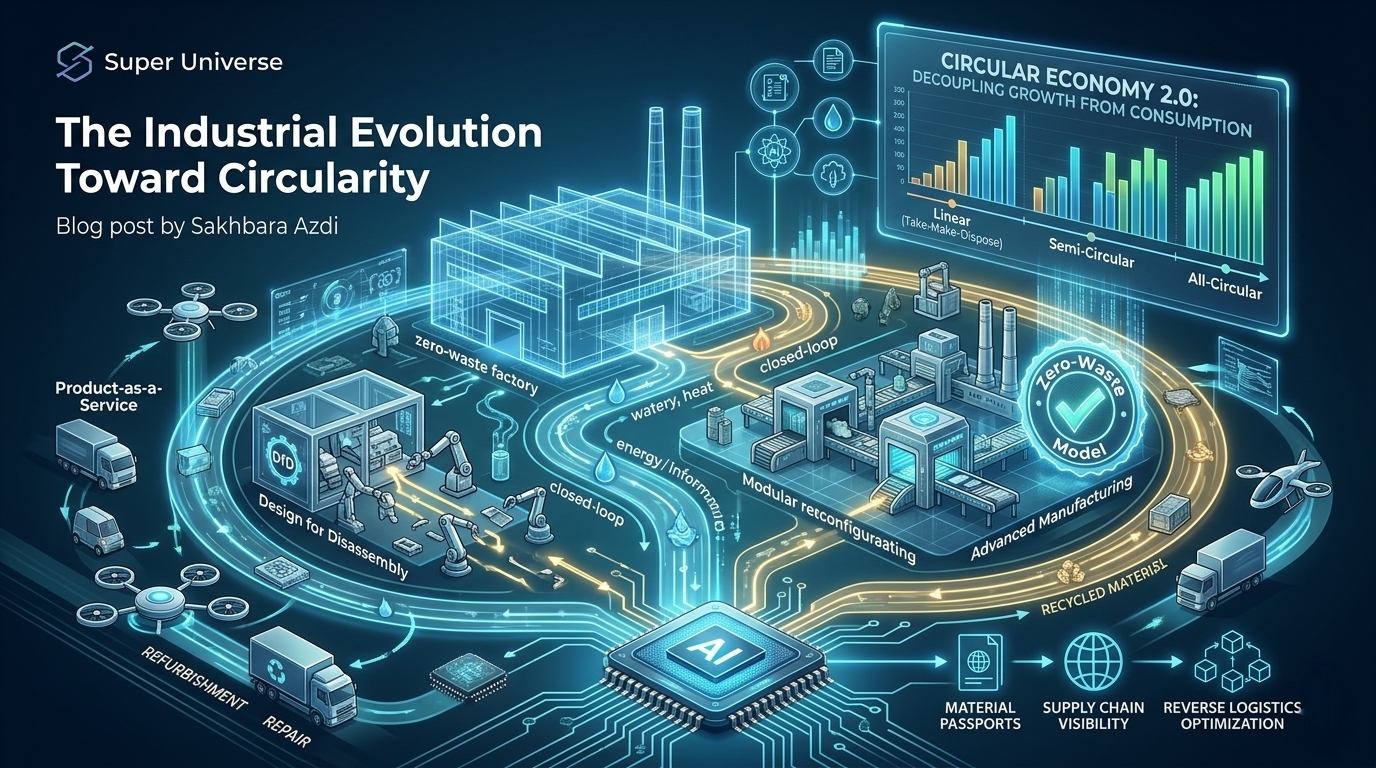

The Industrial Evolution Toward Circularity
For over a century, the global manufacturing sector has operated on a linear “take-make-dispose” model. Raw materials were extracted, processed into goods, and eventually discarded as waste. This traditional approach assumed that resources were infinite and that the environment could indefinitely absorb the byproducts of industrial production. However, as resource scarcity increases and environmental regulations tighten, this model is reaching its breaking point. The transition to a circular economy is no longer just an environmental ideal; it is a strategic business necessity.
The circularity shift represents a fundamental redesign of how products are conceived, manufactured, and managed at the end of their life cycles. In a zero-waste manufacturing model, the goal is to decouple economic growth from resource consumption. This means designing systems where waste is not an inevitable byproduct but a valuable input for another process. Manufacturers who embrace this shift are discovering that efficiency is the ultimate driver of profitability, reducing their reliance on volatile commodity markets and lowering their long-term operational costs.
Redefining Product Design: The Foundation of Zero Waste
A successful transition to a zero-waste model begins long before a single machine is turned on. It starts in the design phase. It is estimated that over 80% of a product’s environmental impact is determined during the initial design stage. Traditional design focuses on functionality and cost, often ignoring what happens to the product once it leaves the consumer’s hands. Circular design, however, prioritizes longevity, repairability, and recyclability.
Engineers are now adopting “Design for Disassembly” (DfD) principles. This involves creating products that can be easily taken apart at the end of their life, allowing components to be refurbished or materials to be separated for high-quality recycling. Instead of using permanent glues or complex composites that are impossible to recycle, manufacturers are moving toward modular designs and mono-materials. This foresight ensures that when a product reaches the end of its functional life, it does not become a liability in a landfill but remains an asset within the production loop.
Closed-Loop Production Systems and Resource Recovery
Once a product is designed for circularity, the manufacturing process itself must be optimized to eliminate waste. This is achieved through closed-loop systems where water, energy, and materials are captured and reused within the facility. For instance, many industrial processes generate significant amounts of heat that are traditionally vented into the atmosphere. In a zero-waste model, heat recovery systems capture this energy and redirect it to other parts of the plant, drastically reducing overall energy consumption.
Material waste, such as scrap metal, plastic trimmings, or chemical byproducts, is also addressed through internal recycling loops. Rather than paying for waste disposal, companies are investing in onsite processing equipment that turns production scrap back into raw material. In cases where internal reuse isn’t possible, manufacturers are forming industrial symbioses. In these arrangements, the waste stream of one factory becomes the raw material for a neighboring facility. This ecosystem approach transforms industrial parks into interconnected hubs where nothing is lost and every output has a designated purpose.
The Role of Digitalization and Industry 4.0
The complexity of managing circular supply chains requires a level of transparency and data accuracy that traditional methods cannot provide. This is where Industry 4.0 technologies become indispensable. The integration of the Internet of Things (IoT), big data analytics, and blockchain is providing the visibility needed to track materials throughout their entire lifecycle. Digital twins—virtual replicas of physical products—allow manufacturers to simulate different end-of-life scenarios and optimize for the highest material recovery rate.
Smart sensors on the factory floor can monitor resource consumption in real-time, identifying inefficiencies and predicting maintenance needs before a machine failure leads to wasted batches of products. Furthermore, blockchain technology is being used to create “material passports.” These digital records document exactly what a product is made of, its origin, and how it should be recycled. This transparency is crucial for the secondary materials market, as it gives recyclers the confidence they need to process complex industrial goods safely and efficiently.
Supply Chain Transformation and Reverse Logistics
Transitioning to a zero-waste model requires a radical rethinking of the relationship between manufacturers and their suppliers. In a linear model, the relationship often ends at the point of sale. In a circular model, the manufacturer remains responsible for the product’s material value. This shift necessitates the development of robust reverse logistics networks—the infrastructure needed to bring products back from the consumer to the factory.
Many leading manufacturers are moving toward “Product-as-a-Service” (PaaS) business models. Instead of selling a physical good, they lease the utility of the product to the customer. For example, a lighting manufacturer might sell “lux” (light) rather than lightbulbs. This incentivizes the manufacturer to build the most durable, energy-efficient product possible, as they retain ownership and are responsible for maintenance and end-of-life processing. When the manufacturer owns the materials, they have a direct financial interest in ensuring those materials are recovered and fed back into the production line.
Overcoming Economic and Cultural Barriers
Despite the clear benefits, the shift to circularity faces significant hurdles. One of the primary challenges is the “linearity bias” embedded in current financial accounting and tax systems. Virgin raw materials are often artificially cheap because their environmental costs are not priced in, while labor-intensive activities like repair and refurbishment are taxed at higher rates. To overcome this, forward-thinking companies are adopting internal carbon pricing and total cost of ownership models to justify the initial investment in circular infrastructure.
Cultural shifts within the organization are equally important. Moving to zero-waste requires cross-departmental collaboration that breaks down traditional silos. Procurement teams must work closely with product designers, and marketing teams must learn to sell the value of refurbished or “second-life” goods to consumers. Leadership must foster a culture of innovation where waste is viewed as a design flaw rather than an unavoidable cost of doing business. When employees at every level are incentivized to find resource-saving opportunities, the transition gains unstoppable momentum.
Policy Frameworks and the Future of Manufacturing
The global regulatory landscape is rapidly evolving to support the circularity shift. Governments are introducing Extended Producer Responsibility (EPR) laws, which hold manufacturers financially responsible for the entire life cycle of their products. From the European Union’s Circular Economy Action Plan to new plastic pacts in North America and Asia, the message is clear: the “polluter pays” principle is becoming the standard. These regulations are creating a level playing field where circular companies are no longer at a competitive disadvantage against those that externalize their waste costs.
As these policies expand, we will likely see a move toward mandatory recycled content requirements for new products. This will create a permanent, high-value market for recovered materials, further incentivizing companies to invest in zero-waste technologies. The manufacturers who lead this transition will not only be more resilient to regulatory shocks but will also be the ones who define the standards of the next industrial era.
The Competitive Advantage of a Zero-Waste Future
The transition to a zero-waste manufacturing model is a journey of continuous improvement. It is not about reaching a perfect state overnight, but about systematically eliminating inefficiencies and reimagining the value of resources. Companies that successfully navigate this shift gain a formidable competitive advantage. They enjoy lower material costs, higher brand loyalty from environmentally conscious consumers, and a more resilient supply chain that is less susceptible to global disruptions.
In the coming decades, the distinction between “manufacturing” and “recycling” will continue to blur. The factories of the future will be sophisticated resource recovery centers, fueled by renewable energy and guided by digital intelligence. By embracing circularity today, manufacturers are ensuring their relevance in a world where resources are finite, but innovation is limitless. The shift to zero waste is more than a trend; it is the blueprint for a sustainable and prosperous industrial future.