


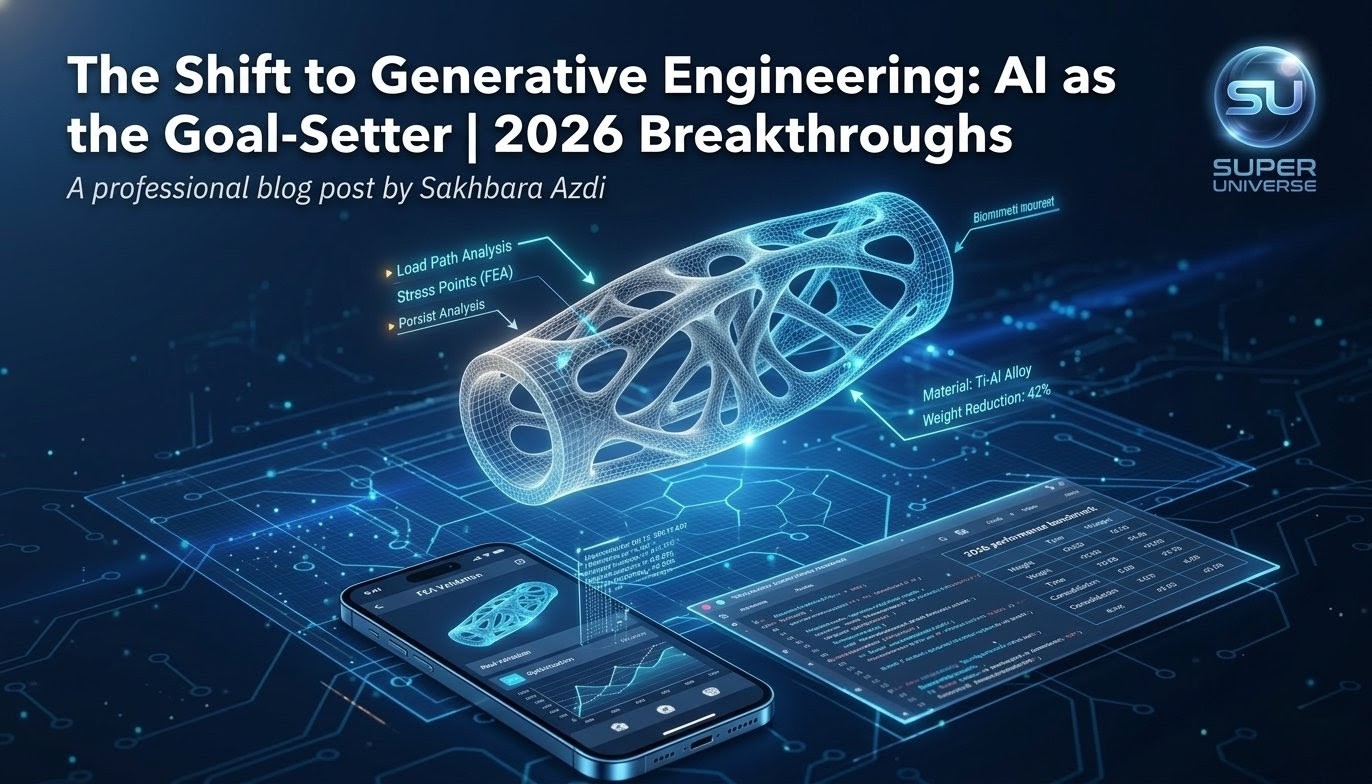

As of April 2026, the field of mechanical engineering is undergoing its most radical transformation since the industrial revolution. We have moved beyond Computer-Aided Design (CAD)—where a human draws a part and the computer stores it—to Generative Engineering, where a human defines the “problem” and an AI “hallucinates” the solution.
By utilizing advanced reasoning models and multi-modal AI agents, engineers are now creating geometries that are not only “non-intuitive” but physically impossible for a human mind to conceptualize. These parts often resemble biological structures—bone, coral, or root systems—reflecting a shift from “rectangles and circles” to “organic optimization.”
The Shift: From Geometry to Goals
In traditional 20th-century engineering, a designer would start with a sketch based on their intuition and then refine it through endless iterations. In 2026, the engineer’s role has shifted to a “Goal-Setter.”
Using tools like Autodesk Fusion 360 or nTopology, an engineer inputs specific constraints:
-
Load Paths: Where the force will hit the part (e.g., $15,000$ Newtons of pressure on the X-axis).
-
Material Constraints: The use of specific titanium alloys or carbon-fiber composites.
-
Manufacturing Method: Whether the part will be 3D printed (Additive), cast, or CNC machined.
-
Performance Targets: Minimum weight, maximum stiffness, or specific thermal dissipation rates.
The AI then explores thousands of design permutations simultaneously, evaluating each against Finite Element Analysis (FEA) in seconds.
The 2026 Performance Benchmarks
Recent data from industrial leaders like Airbus and NASA (April 2026) highlights the staggering efficiency of generative engineering:
| Metric | Traditional Design | Generative Engineering (2026) |
| Weight Reduction | Baseline (100%) | 30% – 50% lighter |
| Development Time | Weeks/Months | Hours/Days |
| Part Consolidation | Multiple components | Single unified part |
| Material Waste | High (Subtractive) | Minimal (Optimized) |
By consolidating twenty separate brackets and fasteners into a single, AI-designed lattice structure, manufacturers are reducing “failure points” while drastically lowering the carbon footprint of their supply chains.
Biomimicry and Lattice Structures
The most striking feature of 2026 mechanical parts is their Biomimetic appearance. AI models have discovered that the most efficient way to handle complex stress is through Lattice Structures—microscopic, repetitive patterns that mimic the internal structure of bird bones.
These parts provide:
-
High Strength-to-Weight Ratio: Perfect for the “Autonomous Logistics” drone swarms that require ultra-light components to maximize battery life.
-
Thermal Management: AI-designed heat exchangers now feature fractal-like internal channels that increase surface area by $400\%$ compared to traditional designs, allowing for much smaller cooling systems in high-performance EVs.
The Synergy with Additive Manufacturing (3D Printing)
Generative engineering would be useless if we couldn’t build what the AI designs. In 2026, the synergy between Generative AI and Industrial 3D Printing is total. Traditional “Subtractive” manufacturing (milling/turning) cannot reach the internal cavities and complex curves of a generative part.
Using Autonomous Toolpath Generation, AI agents now translate a generative design directly into a 3D print file, optimizing the support structures and print orientation to ensure the part doesn’t fail during fabrication. In April 2026, over 80% of aerospace startups have adopted a “Generative-First” workflow, treating 3D printing as the primary—not secondary—manufacturing method.
The Human Role: From Drafter to Curator
A common concern in 2026 is whether AI will replace mechanical engineers. The reality is a shift in skillset. While the AI creates the geometry, the human engineer must act as the Curator and Safety Auditor.
-
Validation: Ensuring the AI didn’t “hallucinate” a design that looks strong but contains hidden stress concentrations.
-
Trade-off Analysis: Evaluating which of the 500 AI-generated options best balances cost versus performance.
-
Regulatory Compliance: Navigating the complex legal landscape of “AI-Certified” parts in safety-critical industries like aviation or medicine.
The Ethical Frontier: Who Owns the Design?
As generative engineering becomes the norm, a new legal debate has emerged in 2026 regarding Intellectual Property. If an AI creates a part that saves a company $100$ million in fuel costs, who owns the patent? Current 2026 rulings suggest that “Human-in-the-Loop” requirements are essential for patentability, reinforcing the idea that AI is a tool of the engineer, not a standalone creator.
The Future of the “Living Machine”
As we move toward 2030, generative engineering is evolving into “Agentic Design.” We are seeing the first instances of “Self-Designing” machines—AI agents that monitor a robot’s wear-and-tear in real-time and automatically generate a reinforced replacement part to be 3D printed on-site.
Generative engineering has allowed us to move past the limitations of human imagination. We are no longer building machines that look like they were made by humans; we are building machines that look like they were grown by nature, but with the precision of the most advanced silicon.
As you consider your own 3D visualizations for your office or your work on Fiverr, do you see “Generative Design” as a tool you would use to optimize your physical workspace, or do you prefer the traditional, human-led aesthetic?